
Modern SaaS platforms built on cloud‑native architectures frequently consist of dozens of independently deployed microservices. A single customer request entering the platform at the ingress layer may traverse authentication services, orchestration engines, data services, and downstream integrations before completing. When failures or performance regressions occur, platform operators must answer a fundamental question: what happened to this specific request, and where?
In many environments, answering this question remains difficult. Although services emit logs and metrics, these signals are disconnected. Telemetry is produced independently by each service without a shared request context, making it difficult to correlate failures, retries, or latency spikes into an end‑to‑end narrative.
This article presents a product‑led framework for designing ingress request tracing in multi‑tenant SaaS platforms. The focus is on design principles and observable system behavior, not implementation code. The framework builds on industry standards such as OpenTelemetry and W3C Trace Context and is applicable to Kubernetes‑based environments.
The observability problem
Without end‑to‑end tracing, ingress requests cannot be reliably followed as they traverse downstream services. Failures appear as isolated events. Latency regressions are visible only in aggregate metrics. Multi‑service workflows and intermittent issues are especially difficult to diagnose.
Operational teams compensate by manually correlating logs using timestamps, heuristics, and partial identifiers. This approach does not scale with service growth and results in slower diagnosis, higher cognitive load during incidents, and reduced confidence in root cause analysis.
The core challenge is not insufficient telemetry, but the lack of consistent request‑level context linking all operations together.
A product-led framework for ingress request tracing
This framework treats distributed tracing as a first‑class platform capability rather than a service‑level implementation choice. At its core are two complementary identifiers: a Trace ID that groups all work for a single customer request, and Span IDs that identify individual units of work (such as a service call or database query) within that trace.
Every ingress request must have an associated trace identifier. If an incoming request does not contain a trace ID, the ingress layer generates one. If a valid trace ID is already present, it is preserved.
1. Trace ID and span ID generation and preservation
Each service processing the request creates its own span and assigns a unique span ID to that unit of work. When the service makes a downstream call, it passes both the trace ID (unchanged) and its span ID (which becomes the parent span ID for the next service). This creates a parent‑child relationship that allows the observability platform to reconstruct the exact sequence and hierarchy of all operations.
This generate‑or‑preserve rule ensures interoperability with upstream systems while maintaining trace continuity within the platform. Both the trace ID and current span ID are attached to the request context and included in response headers so they can be used as deterministic lookup keys during investigations.
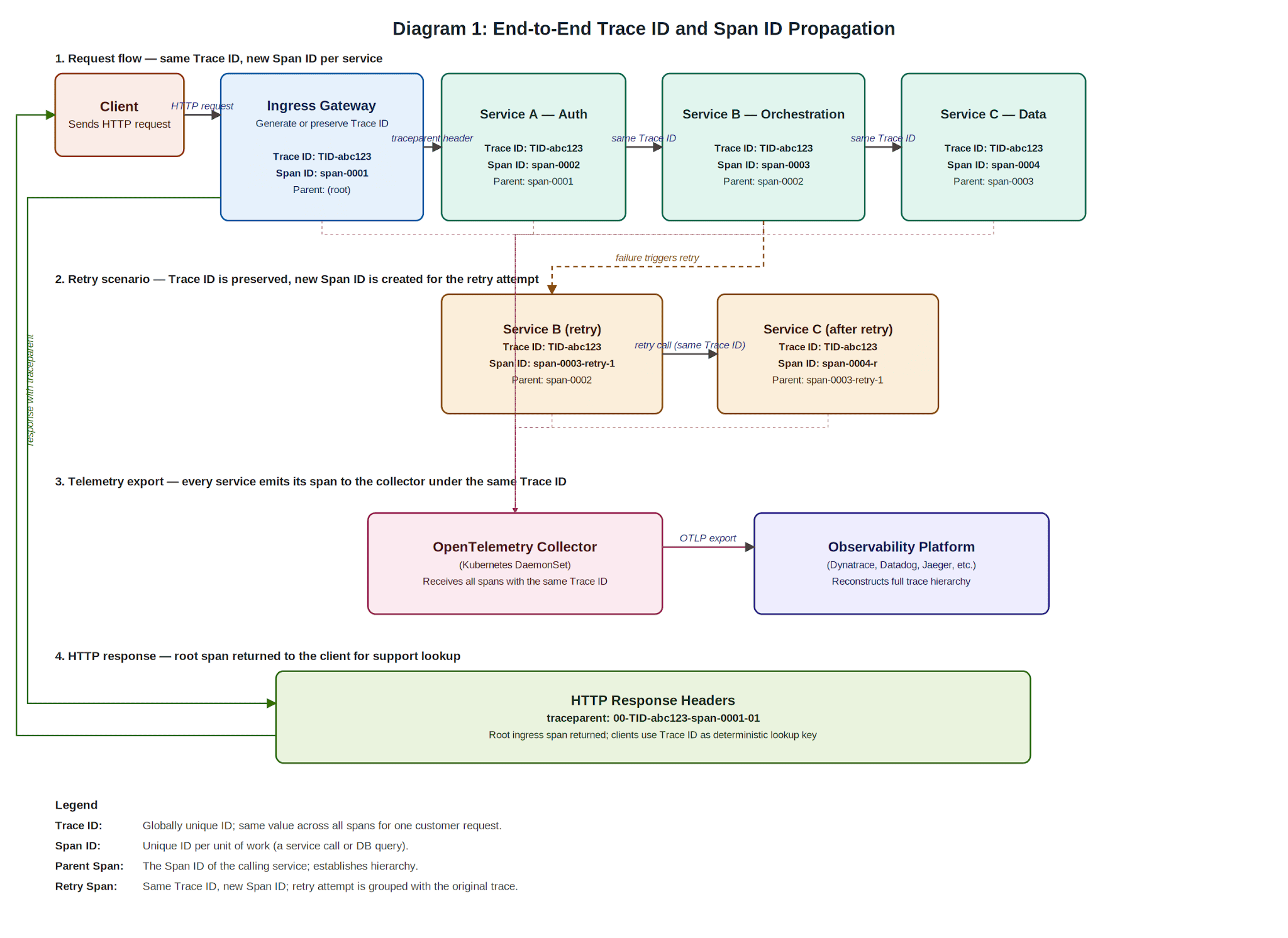
Figure 1: End-to-End trace ID and span ID propagation
In the diagram above, a single Trace ID flows unchanged through all services (auth, orchestration, data layer), representing the customer’s complete request. Each service creates its own Span ID; when Service A calls Service B, it passes both the Trace ID and its own Span ID (which Service B records as its parent). This hierarchy allows operators to see not just that a request failed, but exactly which service and at which point in the sequence.
2. Consistent context propagation
All synchronous service‑to‑service calls reuse the same trace ID. Each service creates a new span ID for its own work. Retry operations preserve the original trace ID but may create additional span IDs for each retry attempt, allowing the observability platform to distinguish between the original call and subsequent attempts while keeping them grouped under the same trace.
Where asynchronous processing exists, trace context (both trace ID and parent span ID) is propagated via message metadata to prevent observability gaps as workflows evolve.
3. Security-First Trace Metadata
Trace data is limited to operational metadata only: trace ID, span ID, parent span ID, service name, operation name, timestamps, duration, and execution status.
Request payloads, credentials, secrets, tokens, and personally identifiable information are explicitly excluded by design. Treating data exclusion as a design constraint simplifies security reviews and reduces long‑term compliance risk.
4. Configuration-Only Telemetry Export
Trace export is managed entirely via Kubernetes configuration. Operators can configure exporters, credentials, and routing parameters without application code changes.
This decouples tracing operations from release cycles and allows teams to evolve observability using existing SRE workflows.
5. Non-Disruptive Failure Modes
Tracing must never block request processing. If telemetry backends are unavailable or misconfigured, requests complete successfully. Trace data may be buffered or dropped, but customer experience is unaffected.
Partial traces are acceptable. Failed requests are not.
Acceptance criteria as executable contracts
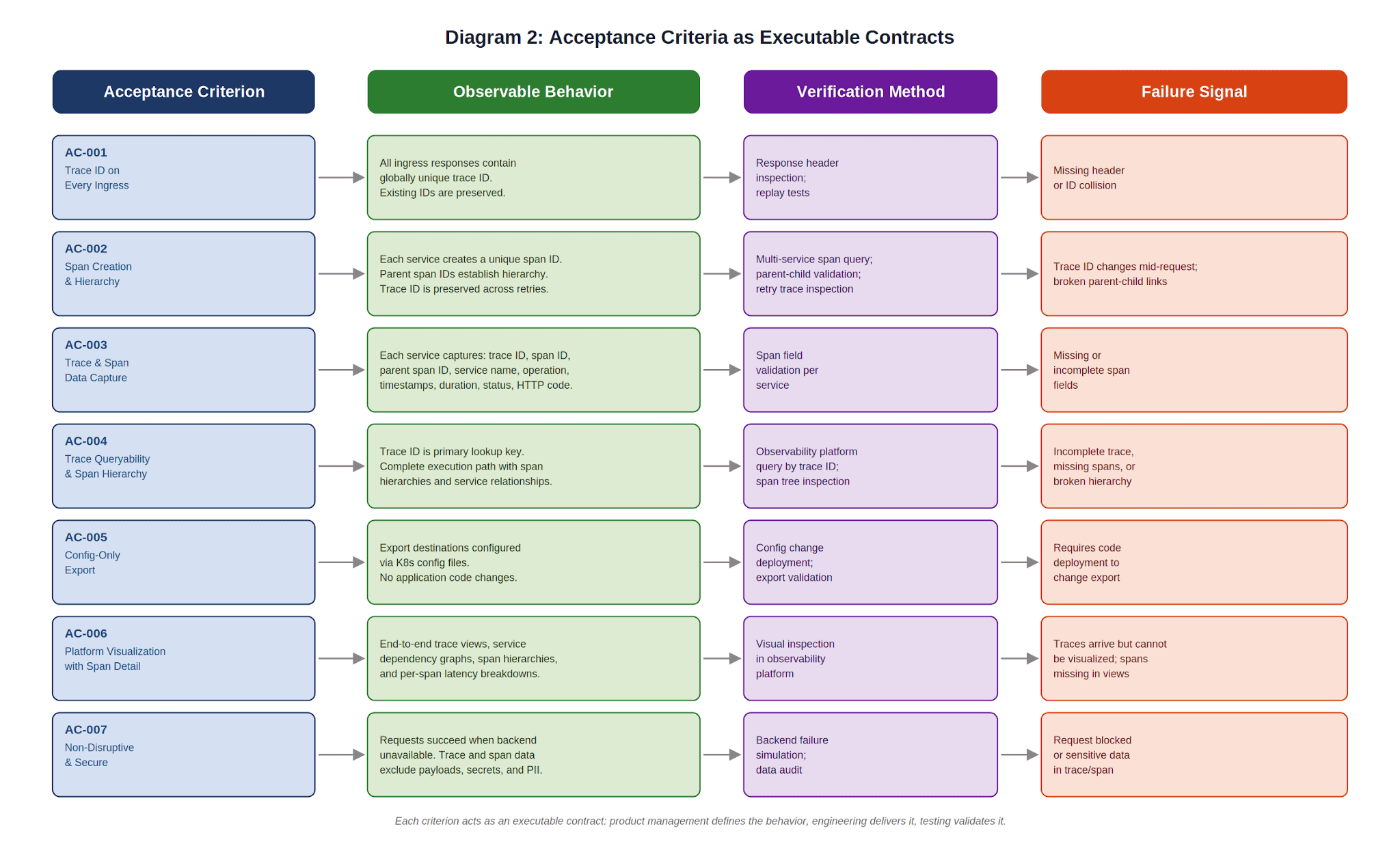
Clear acceptance criteria define observable system outcomes, not implementation details. In this framework, acceptance criteria act as executable contracts between product management and engineering. Each criterion maps to a specific requirement and is independently testable.
| AC ID | Observable Behavior | Requirement Area |
| AC-001 | Every ingress request includes a globally unique trace ID in response headers. Trace IDs already present in incoming requests are preserved and propagated unchanged. | Trace ID Generation & Preservation |
| AC-002 | All platform services processing an ingress request create their own span with a unique span ID. Parent‑child relationships are established through parent span IDs. Retry operations preserve the original trace ID. | Span Creation & Hierarchy |
| AC-003 | Each platform service captures trace-level execution data including trace ID, span ID, parent span ID, service name, operation name, timestamps, duration, status, and HTTP response code. | Trace Data Capture |
| AC-004 | SREs can query traces using a trace ID as a primary lookup key in observability platforms and view the complete execution path with service-to-service relationships via span hierarchies. | Trace Queryability |
| AC-005 | SREs can configure trace export destinations via Kubernetes configuration files without application code changes. Multiple backends and tenant-specific routing are supported. | Config-Only Export |
| AC-006 | Traces exported to observability platforms are visualizable with end-to-end trace views, service dependency graphs, span hierarchies, and latency breakdowns per service and span. | Platform Visualization |
| AC-007 | Tracing does not block or fail requests when the telemetry backend is unavailable. Trace data excludes sensitive payload information, credentials, and PII by design. | Non-Disruptive & Secure |
These criteria prevent partial adoption, reduce ambiguity during implementation, and provide a stable basis for regression validation as the platform evolves.
Quantifying business value
Infrastructure initiatives frequently fail because they cannot articulate business value beyond engineering. The value proposition for this type of initiative should be constructed around measurable operational dimensions:
| Value Dimension | Quantified Impact |
| Root Cause Identification | Shift from heuristic-based to deterministic tracing via trace and span hierarchies; elimination of manual log correlation |
| Operational Scalability | Observability scales linearly with service count rather than degrading with complexity; span‑level granularity enables micro-service level diagnostics |
Understanding trace and span context
The W3C Trace Context standard defines how trace information propagates across services. It specifies two HTTP headers: traceparent carries the essential identifiers, and tracestate carries vendor-specific metadata. The traceparent header format is version‑trace‑id‑span‑id‑flags (for example, 00‑abc123‑def456‑01).
Trace ID: Globally unique identifier that groups all spans belonging to a single customer request. Unchanged as the request flows through all services. Enables support teams to look up the entire request path.
Span ID: Unique identifier for a single unit of work (e.g., API call, database query). Each service creates its own span ID. When making downstream calls, the current span ID becomes the parent span ID for the next service, establishing a parent‑child relationship.
Parent Span ID: The span ID of the calling service. Used to reconstruct the sequence and hierarchy of operations. Allows the observability platform to display which service called which service and in what order.
Together, trace ID and span hierarchy enable operators to ask not just ‘did this request fail’ but ‘exactly where in the sequence did it fail, and what was the sequence of calls that led to that point.’
Operational impact
Ingress request tracing shifts troubleshooting from inference to direct observation. Engineers can follow individual requests across services instead of reconstructing behavior from disconnected signals. With trace and span IDs, the entire execution path is visible: which services were called, in what order, and how much time each spent.
The qualitative benefits are immediate and significant: faster localization of failures through trace ID lookup and span hierarchy analysis, clearer cross‑team communication using shared trace references instead of symptom descriptions, reduced cognitive load during incidents as SREs observe the exact sequence rather than hypothesize, and proactive performance management through per‑service and per‑span latency decomposition.
For small SRE teams supporting complex platforms, these improvements are transformative. A single SRE with a trace can achieve what previously required a cross‑team war room.
The hardest part Is not technical
The most underestimated challenge in any tracing initiative is organizational, not technical. A distributed tracing system is only as complete as its coverage. If three out of eight services in a request path propagate trace context and five do not, the result is a trace with large gaps that is operationally unreliable. Worse, broken span‑parent relationships make the hierarchy useless.
The solution combines technical enforcement with organizational process: automated CI/CD checks that reject deployments without trace instrumentation and proper span creation, a documented onboarding checklist for every service team, and sustained adoption tracking until 100% propagation is achieved. Without this sustained attention, adoption stalls at the teams that opt in voluntarily, leaving critical gaps in exactly the services where tracing is most needed.
Replicating this framework
This framework is designed to be replicable across any multi‑service SaaS platform running on container orchestration infrastructure. The design principles—generate or preserve trace IDs, create unique span IDs per service with parent‑child relationships, capture only operational metadata including span IDs, export through configurable backends, and degrade gracefully—are architecture‑agnostic and applicable regardless of the specific microservices framework, programming languages, or observability backend in use.
Organizations considering adoption should pay particular attention to two areas: failure mode design (ensuring tracing cannot cause outages) and organizational adoption strategy (ensuring complete service coverage through both technical enforcement and process). These are the most common points of failure in distributed tracing deployments and the areas where published guidance is most sparse.
Natural extensions include expanding to asynchronous message‑based workflows, implementing intelligent sampling strategies, correlating trace and span data with infrastructure‑level signals, and ultimately leveraging historical span patterns for predictive operations.
Conclusion
Distributed tracing is foundational to operating cloud‑native platforms at scale, but tooling alone is insufficient. By treating tracing as a product capability with clear guarantees, acceptance criteria as executable contracts, and failure‑mode discipline, platforms can deliver reliable request‑level visibility without compromising security or availability.
The gap in our industry is not in tracing tools—OpenTelemetry, Jaeger, Zipkin, and commercial platforms have solved the instrumentation and visualization layers. The gap is in the product and operational decisions required to deploy tracing successfully: how to scope it, how to secure it, how to make it operator‑friendly, how to ensure complete adoption, how to establish span hierarchies that reveal the true sequence of operations, and how to measure its impact. That is the gap this framework addresses.