

The CNCF Technical Oversight Committee (TOC) has voted to accept Fluid as a CNCF incubating project.
What is Fluid?
Kubernetes provides a data access layer through the Container Storage Interface (CSI), enabling workloads to connect to storage systems. However, certain use cases often require additional capabilities such as dataset versioning, access controls, preprocessing, dynamic mounting, and data acceleration.
To help address these needs, Nanjing University, Alibaba Cloud, and the Alluxio community introduced Fluid, a cloud native data orchestration and acceleration system that treats “elastic datasets” as a first-class resource. By adding a data abstraction layer within Kubernetes environments, Fluid enhances data flow and management for data-intensive workloads.
Fluid’s vision is Data Anyway, Anywhere, Anytime:
- Anyway: Fluid focuses on data accessibility. Storage vendors can flexibly and simply integrate various storage clients without needing deep or extensive knowledge of Kubernetes CSI or Golang programming.
- Anywhere: Fluid facilitates efficient data access across diverse infrastructure by supporting heterogeneous computing environments (cloud, edge, and serverless). It accelerates access to various storage systems like HDFS, S3, GCS, and CubeFS by utilizing caching engines such as Alluxio, JuiceFS, and Vineyard.
- Anytime: Runtime dynamic adjustment of data sources allows data scientists to add and remove storage data sources on-demand in Kubernetes environments without service interruption.
Fluid’s Key Milestones and Ecosystem Development
Fluid originated as a joint project from Nanjing University, Alibaba Cloud, and the Alluxio community in September 2020. The project aims to provide efficient, elastic, and transparent data access capabilities for data-intensive AI applications in cloud native environments. In May 2021, Fluid was officially accepted as a CNCF sandbox project.
Since joining the CNCF, Fluid has rapidly grown, continuously releasing multiple important updates, achieving significant breakthroughs in key capabilities such as elastic data cache scaling, unified access to heterogeneous data sources, and application-transparent scheduling, while also improving the operational efficiency of AI and big data workloads on cloud native platforms.
Fluid’s core design concepts and technological innovations have received high-level academic recognition, with related results published in top conferences and journals in the database and computer systems fields, such as IEEE TPDS 2023.
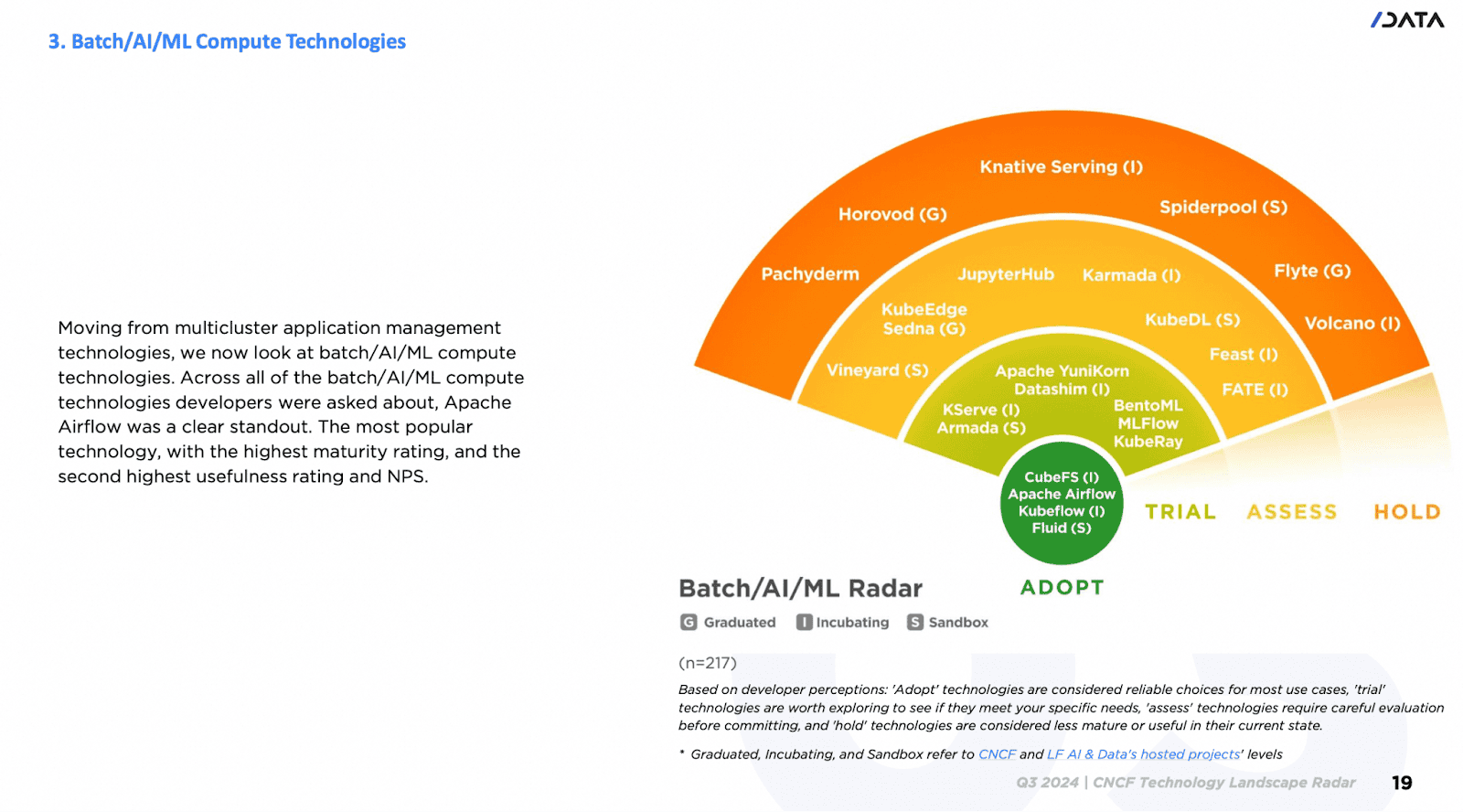
In December 2024, at KubeCon + CloudNativeCon North America, CNCF released the 2024 Technology Landscape Radar Report, where Fluid, along with projects such as Kubeflow, was listed as “Adopt,”becoming one of the de facto standards in the cloud native AI and big data field.
Now, Fluid has been widely adopted across multiple industries and regions worldwide, with users covering major cloud service providers, internet companies, and vertical technology companies. Some Fluid users include Xiaomi, Alibaba Group, NetEase, China Telecom, Horizon, Weibo, Bilibili, 360, Zuoyebang, Inceptio Technology, Huya, OPPO, Unisound, DP Technology, JoinQuant, among others. Use cases cover a wide range of application scenarios, including, but not limited to, Artificial Intelligence Generated Content (AIGC), large models, big data, hybrid cloud, cloud-based development machine management, and autonomous driving data simulation.
A Word from the Maintainers
“We are deeply honored to see Fluid promoted to an incubating project. Our original intention in initiating Fluid was to fill the gap between compute and storage in cloud native architectures, allowing data to flow freely in the cloud like ‘fluid.’ The vibrant community development and widespread user adoption validate our vision. We will continue to drive the evolution of cloud native data orchestration technology, especially when it comes to exploring intelligent scheduling and orchestration of KVCache for large model inference scenarios and dedicating ourselves to making data serve various applications more efficiently and intelligently.”
— Gu Rong (Nanjing University), Chair and Co-Founder of the Fluid Community
“From sandbox to incubation, the concept of ‘caches also needing elasticity’ has gained widespread recognition. In the future, we will continue to drive Fluid toward becoming the standard for cloud native data orchestration, allowing data scientists to focus on model innovation.”
— Che Yang (Alibaba Cloud), Fluid Community Maintainer and Co-Founder
“Fluid is a key bridge to connecting AI computing frameworks and distributed storage systems. Seeing Fluid grow from a sandbox to an incubating project makes us extremely proud. This milestone proves that building a standardized data abstraction layer on Kubernetes is keeping up with industry trends.”
— Fan Bin (Alluxio Inc.), Alluxio Open Source Community Maintainer
Support from TOC Sponsors
The TOC provides technical leadership to the cloud native community. It defines and maintains the foundation’s technical vision, approves new projects, and stewards them across maturity levels. The TOC also aligns projects within the overall ecosystem, sets cross-cutting standards and best practices, and works with end users to ensure long-term sustainability. As part of its charter, the TOC evaluates and supports projects as they meet the requirements for incubation and continue progressing toward graduation.
“Fluid’s progression to incubation reflects both its technical maturity and the clear demand we’re seeing for stronger data orchestration in cloud native environments. As AI and data-intensive workloads continue to grow on Kubernetes, projects like Fluid help bridge compute and storage in a way that is practical, scalable, and community-driven. The TOC looks forward to supporting the project’s continued evolution within the CNCF ecosystem.”
— Alex Chircop, CNCF TOC Member
“Fluid has demonstrated a strong level of maturity that aligns well with CNCF Incubation expectations. Adopter interviews showcase that Fluid has been deployed successfully in large-scale production environments for several years and provides standardized APIs that enable multiple applications to efficiently access and cache diverse datasets. Additionally, Fluid benefits from a healthy, engaged community, with a roadmap clearly shaped by adopter feedback.”
— Katie Gamanji, CNCF TOC Member
Main Components in Fluid
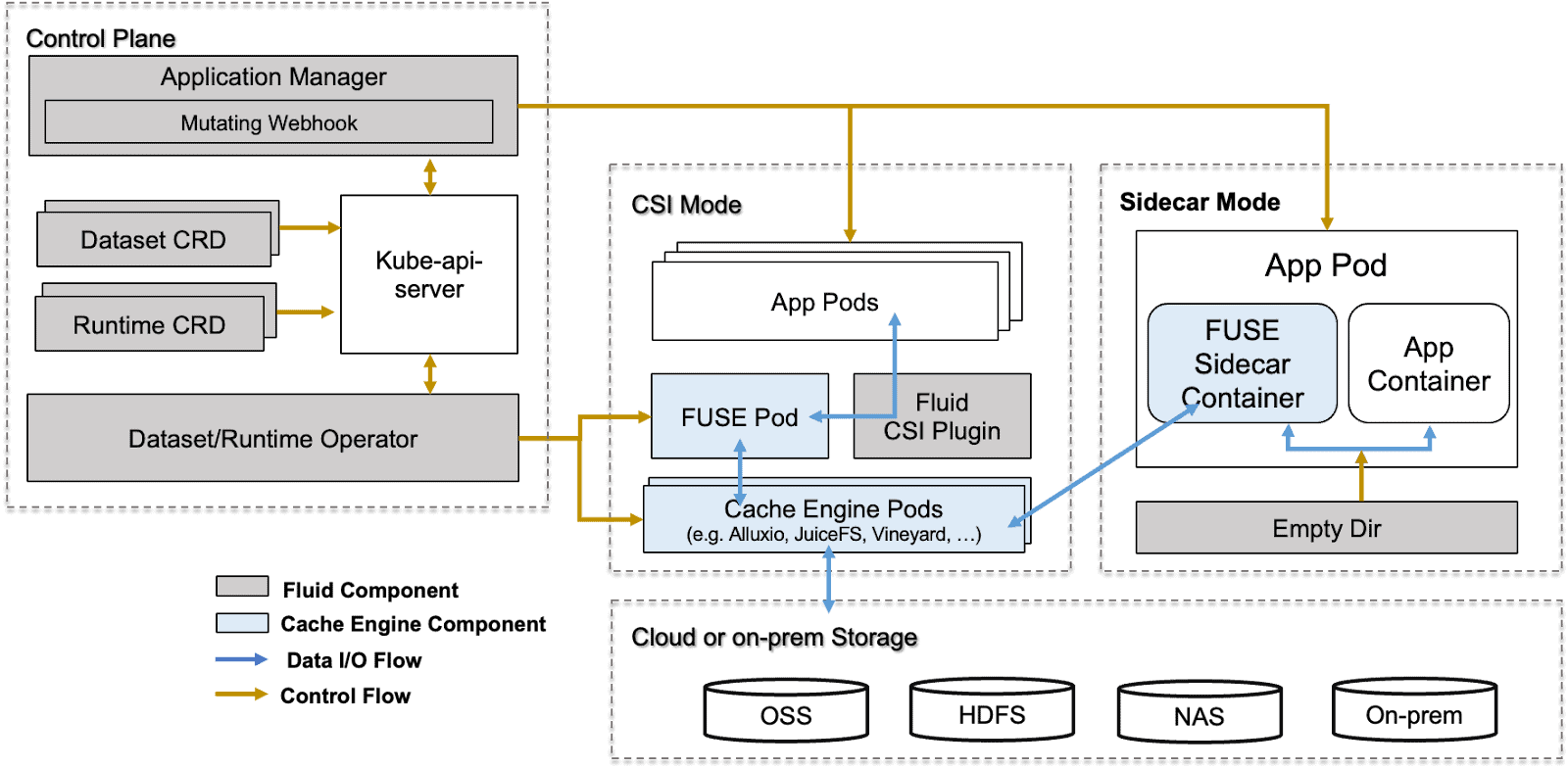
- Dataset Controller: Responsible for dataset abstraction and management, maintaining the binding relationship and status between data and underlying storage.
- Application Scheduler: The application scheduling component is responsible for perceiving data cache location information and scheduling application pods to the most suitable nodes.
- Runtime Plugins: Pluggable runtime interface responsible for deployment, configuration, scaling, and failure recovery of specific caching engines (such as Alluxio, JuiceFS, Vineyard, etc.), with excellent extensibility.
- Webhook: Utilizes the Mutating Admission Webhook mechanism to automatically inject sidecar or volume mount information into application pods, achieving zero intrusion into applications.
- CSI Plugin: Enables lightweight, transparent dataset mounting support for application pods, enabling them to access cached or remote data via local file system paths.
Community Highlights
These community metrics signal strong momentum and healthy open source governance. For a CNCF project, this level of engagement builds trust with adopters, ensures long-term sustainability, and reflects the collaborative innovation that defines the cloud native ecosystem.
- 1.9k GitHub Stars
- 116 pull requests
- 250 issues
- 979 contributors
- 28 Releases
The Journey Continues
Becoming a CNCF incubating project is a turning point for Fluid’s journey. Fluid will continue to deepen its data orchestration capabilities for generative AI and big data scenarios. To meet the exponential growth demands of GenAI applications, Fluid’s next goal is to evolve into an intelligent elastic data platform, allowing users to focus on model innovation and data value mining, while Fluid handles the underlying data distribution, cache acceleration, resource management, and elastic scaling.
As a CNCF incubating project, Fluid will continue to uphold the principles of open source, neutrality, and collaboration, working together with global developers and ecosystem partners to enable data to flow and be efficiently used freely anywhere, anytime.
Hear from Users
“Fluid’s Anytime capability allows our data scientists to self-service data switching without restarting Pods, truly achieving data agility. This is the core reason we chose Fluid over a self-built solution.”
— Liu Bin, Technical Lead at DP Technology
“Fluid’s vendor neutrality and cross-namespace cache sharing capabilities help us avoid cloud vendor lock-in and save approximately 40% in cross-cloud bandwidth costs. It has been deeply integrated into all of our data workflows.”
— Zhao Ming, Head of Horizon AI Platform
“In LLM model inference, remote Safetensors file reading often leads to low I/O utilization. Fluid’s intelligent prefetching and local caching technology allows us to fully saturate bandwidth without modifying code, fully unleashing GPU computing power.”
— Zhang Xiang, Head of NetEase MaaS
As a CNCF-hosted project, Fluid is committed to the principles of open source, neutrality and collaboration. We invite global developers and ecosystem partners to join us in enabling data to flow and be efficiently used freely anywhere, anytime. For more information on maturity requirements for each level, please visit the CNCF Graduation Criteria.