

Enabling 200,000+ Vehicle Sales Across Eight Global Markets with Kubernetes, Dapr, Kyverno, and Velero
Objective
To build a Next Generation Sales Platform that transforms the traditional dealership-based vehicle sales model into a seamless, omnichannel, direct-to-customer experience, leveraging cloud-native technologies and open-source tools.
Introduction
In an industry historically defined by fragmented dealership networks, opaque pricing models, and disconnected customer experiences, a leading global luxury and commercial vehicle manufacturer set out to fundamentally reinvent automotive sales. Operating across eight international markets, Daimler launched an ambitious transformation initiative to replace the traditional dealership-centric model with a fully integrated, direct-to-customer (D2C) digital commerce platform designed for the next generation of automotive buyers.
To realize this vision, Daimler partnered with Infosys to build a cloud-native, scalable, and highly resilient sales ecosystem powered by open-source and CNCF technologies. Built on Microsoft Azure and architected around MACH principles—Microservices, API-first, Cloud-native, and Headless—the platform delivers a seamless omnichannel buying journey spanning lead generation, pricing transparency, vehicle ordering, financing, invoicing, and delivery management.
The transformation was not simply a technology modernization effort; it represented a strategic business shift aimed at redefining customer engagement, accelerating global market expansion, improving operational efficiency, and enabling rapid innovation at scale. Today, the platform supports more than 125 microservices, processes approximately 10 million API calls per day, manages 3TB of daily data workloads, and powers digital vehicle sales across multiple international markets with high availability and zero-downtime deployments.



By the numbers
200,000+
vehicles sold through the Next Generation Sales Platform across eight global markets
10 million
API calls processed daily across a cloud-native platform running 125+ microservices
30%
reduction in infrastructure and operational costs
Challenge
A transformative business vision demanded an equally future-ready technology foundation. The program required carefully balancing large-scale transformation with operational continuity—supporting the organization’s immediate business priorities while establishing a scalable, cloud-native foundation for the “Next Generation Sales Platform.” This meant modernizing legacy systems without disrupting ongoing market operations, while creating an architecture capable of supporting long-term innovation and global expansion.
Daimler also faced significant functional complexity driven by years of market-specific customizations, fragmented integrations, redundant capabilities, and localized business processes across regions. Simplifying this landscape required the creation of a modular, composable functional architecture that could standardize core capabilities while still enabling market-level flexibility and rapid rollout.
In parallel, the program needed to rapidly assemble and scale a high-performing global delivery organization capable of executing at enterprise scale. Establishing the right operating model, governance structure, and talent mix was critical to ensuring agility, engineering consistency, delivery standardization, and scalable execution across multiple workstreams and international markets.
Solution Architecture Highlights
- Composable Digital Architecture:
- Based on MACH principles: Microservices, API-first, Cloud-native, Headless
- Built on Azure Kubernetes Services (AKS)
- Cloud-Native Microservices Platform:
- 125+ microservices, 425+ pods, 3TB data/day, 10M API calls/day
- Event-driven architecture with RabbitMQ, Redis, DAPR
- PostgreSQL and Neo4J for persistence and graph data
- Apache Superset for reporting, ClamAV for file scanning, Gottenburg for PDF generation
- Observability & Security:
- DataDog & Azure Monitor for 360° observability
- DevSecOps, SAST/DAST, penetration testing
- Policy & Backup Management:
- Kyverno for policy enforcement
- Velero for cluster backup
Solution Approach
To address the complexities of global automotive sales transformation, Daimler adopted a blueprint-driven delivery strategy designed to balance global standardization with market-specific flexibility. The program identified and prioritized core business capabilities that could be consistently deployed across regions, while leveraging fit-gap analysis to accelerate localization and country-specific rollouts. By industrializing and templatizing the feature development lifecycle, the organization established a repeatable delivery model that improved scalability, reduced implementation complexity, and ensured consistent user experiences across markets. Active collaboration with regional business stakeholders further enabled faster adoption and alignment with local operational requirements.
From a technology perspective, the platform was built on a composable digital architecture grounded in MACH principles—Microservices, API-first, Cloud-native, and Headless—providing the scalability, flexibility, and resilience required for a modern direct-to-customer automotive ecosystem. The transformation included a phased cloud migration strategy to Microsoft Azure, enabling controlled modernization while minimizing operational disruption. Comprehensive observability was implemented using DataDog and Azure Monitor to provide real-time operational visibility across distributed services, while enterprise-grade security practices—including DevSecOps pipelines, SAST/DAST tooling, penetration testing, and independent audits—ensured governance, compliance, and platform resilience at scale.
Execution success was driven by agile delivery methodologies combined with a strategically structured global engineering organization. Experienced domain and platform specialists were embedded into key workstreams, while a mentor-mentee operating model enabled rapid workforce scaling through structured onboarding and capability development. A dedicated quality engineering and governance task force leveraged automation frameworks, KPI-driven performance management, and continuous monitoring of metrics such as UAT readiness, delivery velocity, defect leakage, and scope management to maintain high delivery standards and alignment with business objectives throughout the transformation journey.
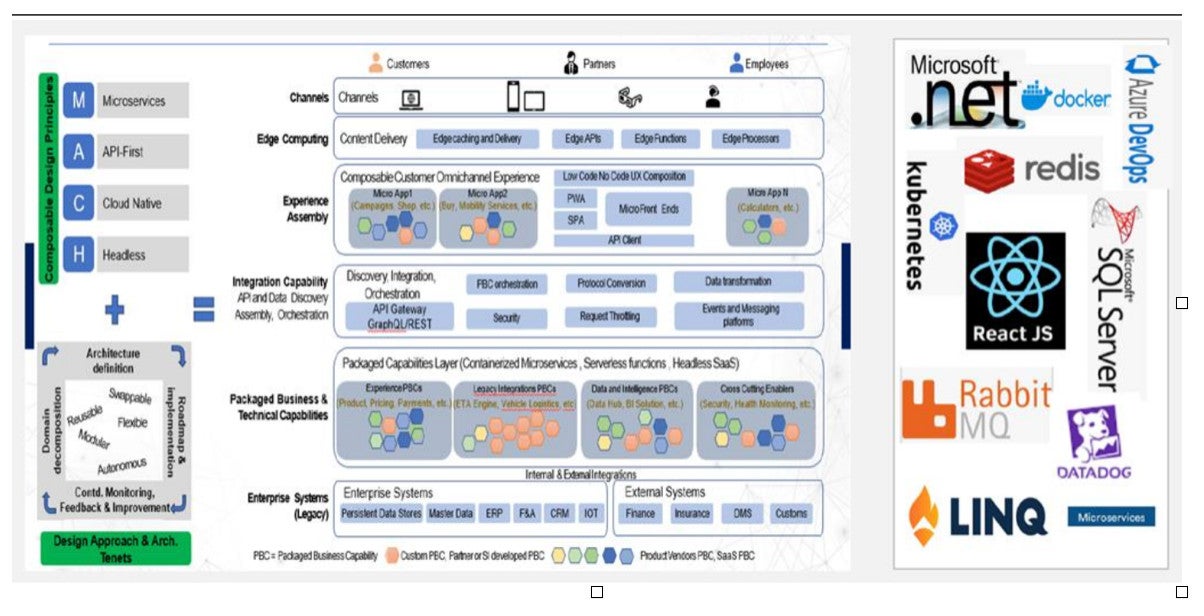
Architecture Diagram
Solution
The “Next Generation Sales Platform” was designed as a centralized, cloud-native transaction ecosystem capable of orchestrating the entire automotive customer lifecycle—from inventory visibility and CRM interactions to quotations, financing, contracting, invoicing, and final vehicle delivery. By consolidating previously fragmented sales processes into a unified digital platform, the solution enabled a seamless, transparent, and omnichannel customer experience across global markets. Built on an event-driven microservices architecture, the platform delivers real-time responsiveness, operational scalability, and end-to-end observability across critical business workflows, while a centralized enterprise data lake powers advanced reporting, analytics, and business intelligence capabilities.
The transformation was executed through a phased modernization strategy that prioritized business continuity while accelerating cloud adoption. Critical applications were migrated from on-premises infrastructure to Microsoft Azure, while legacy monolithic systems were progressively decomposed into granular, independently deployable microservices aligned with 12-factor application principles and modern data management patterns, including NoSQL adoption. This approach significantly improved platform agility, deployment velocity, resilience, and scalability, enabling faster feature releases and simplified operational management across markets.
At the core of the platform is Azure Kubernetes Service (AKS), which provides dynamic orchestration and auto-scaling capabilities for more than 125 microservices and 425 pods supporting high-volume transactional workloads, market launches, and large-scale sales campaigns. The platform integrates containerized managed services through a CaaS operating model, leveraging RabbitMQ for event-driven messaging, Kong Gateway for API management, PostgreSQL and Neo4J for transactional and graph-based data processing, and Apache Superset for enterprise reporting and analytics. Redis Enterprise with RediSearch improved critical API response performance by 90%, particularly for high-volume stock search operations. Additional platform services include ClamAV for secure file scanning, Gotenberg for document and PDF generation, and DAPR for distributed state management and service orchestration.
To strengthen operational governance and platform reliability, the solution incorporated several CNCF technologies, including Helm for standardized application deployment, Kyverno for policy-based governance and compliance enforcement, and Velero for Kubernetes-native backup and disaster recovery management. Supporting six deployment environments and more than 200 CI pipelines, the platform processes approximately 3TB of data and nearly 10 million external API calls per day. Together, these capabilities established a highly scalable, resilient, and future-ready digital commerce platform that delivers significant improvements in operational efficiency, platform stability, deployment automation, and cost optimization.
Program benefits
Strategic & Business Impact
- Positioned client as a market leader in the luxury automotive segment with an early mover advantage.
- Platform successfully launched in 8 global markets.
- Enabled sale of 200K+ vehicles, generation of 850K+ leads, and built a 610K+ customer base.
Stakeholder Benefits
- OEM: National pricing, centralized stock visibility, transparent order management.
- Dealers: Reduced financial and operational risks, improved profitability.
- Customers: Seamless omnichannel experience, product visibility, and “Best Price” guarantee.
Market Adoption
- 30% increase in online vehicle sales in launched markets, indicating strong customer readiness.
Technical Benefits
- Future-ready platform with optimized performance and cost.
- 40% faster response times, 90% API performance improvement (e.g., stock search).
- 30% cost reduction via cloud migration and tech transformation.
- Zero downtime deployments with enhanced resiliency and circuit breakers.
- Scalable microservices architecture with auto-scaling capabilities.
- Improved operational excellence through modern integrations and 360° observability.
Conclusion
The Next Generation Sales Platform has become a cornerstone of Infosys’ client’s global digital transformation strategy, enabling the organization to transition from a traditional automotive sales model to a modern, software-defined customer engagement platform. By embracing cloud-native architecture, CNCF technologies, and platform engineering principles, Daimler established a scalable foundation capable of supporting rapid market expansion, continuous innovation, and evolving customer expectations.
The business impact has been substantial: the platform has enabled the sale of more than 200,000 vehicles, generated over 850,000 leads, and supported a customer base exceeding 610,000 users across eight markets. Operationally, the transformation delivered 40% faster response times, 90% API performance improvements for critical workflows such as stock search, and a 30% reduction in infrastructure and operational costs through cloud migration and modernization.
Beyond measurable outcomes, the initiative demonstrates how cloud-native technologies can drive enterprise-wide transformation in highly complex and globally distributed industries. Through Kubernetes-based scalability, event-driven microservices, policy-driven governance with Kyverno, automated deployments with Helm, and resilient backup strategies using Velero, the client successfully built a future-ready digital commerce platform engineered for resilience, agility, and long-term growth.
As Daimler continues expanding its direct-to-customer strategy into additional markets and customer touchpoints, the platform provides a strong foundation for future innovation in connected mobility, digital retail experiences, and data-driven automotive services.