

InfoQ: “OpenTelemetry Graduates to CNCF’s Highest Maturity Level”
The Cloud Native Computing Foundation (CNCF) recently announced the graduation of OpenTelemetry, elevating the project to the foundation’s highest level of maturity and formally recognizing it as production-ready for enterprise use.
July 3, 2026

Member Post
How data sovereignty is changing cloud native infrastructure design
The core issue isn’t where your server sits. It’s who can be compelled to hand over what’s on it. For years, cloud providers treated sovereignty as a geography problem. Pick a region. Choose a country. Keep...
July 3, 2026 | Dana Cazacu, Marketing Manager, VEXXHOST
Member Post
(re)introducing kpt: Your toolchain for infrastructure automation
What is kpt? The opening tagline of the kpt documentation describes it as “… a package-centric toolchain that enables a WYSIWYG configuration authoring, automation, and delivery experience, which simplifies managing Kubernetes platforms and KRM-driven infrastructure at...
July 2, 2026 | Ciaran Johnston, Ericsson
Ambassador Post
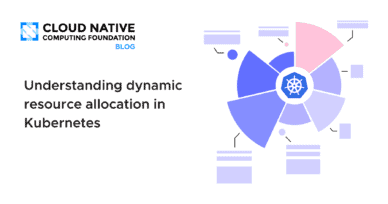
Understanding dynamic resource allocation in Kubernetes
Dynamic Resource Allocation (DRA) recently reached GA in Kubernetes v1.35, and I believe many of us are eager to give it a try. Adding to the momentum, NVIDIA has moved dra-driver-nvidia-gpu into Kubernetes SIGs, with the...
July 1, 2026 | ChengHao Yang, CNCF Ambassador
Ambassador Post
Kepler, re-architected: Improved power accuracy and a community call to action!
Thank you to Laura Llinares, Mary Baldwin Hughes, Vimal Kumar, and Sunil Thaha for their significant contributions to this blog post and the Kepler project. Data centers accounted for 1.5% of global electricity demand in 2024,...
June 30, 2026 | Niki Manoledaki (Grafana Labs), Sunyanan Choochotkaew (IBM) | CNCF Ambassadors
Project Post
Dragonfly v2.5.0 is released
Dragonfly v2.5.0 is released! Thanks to all of the contributors who made this Dragonfly release happen. New features and enhancements Direct repository downloads from Hugging Face and ModelScope Dragonfly Client now supports directly downloading model repositories...
June 30, 2026 | Gaius Qi, Dragonfly Maintainer
Community Post
OTel and mesh-derived metrics: A 2026 reference
If you already run an OpenTelemetry pipeline, you have good visibility into what your applications are doing. This blog post is about what you don’t see yet: the east-west traffic between your services, measured at the...
June 29, 2026 | Mesut Oezdil, DevOps Engineer (written on behalf of Buoyant)
Project Post
etcd-operator joins Cozystack with a new v1alpha2 API
The etcd-operator project, which develops an operator for deploying and maintaining etcd clusters on Kubernetes, has been donated to the Cozystack project. Alongside the donation, a from-scratch implementation of the operator has been published under a...
June 29, 2026 | Andrey Kolkov and Andrei Kvapil, Ænix
InfoQ: “Dapr 1.18 Introduces Verifiable Execution, Bringing Cryptographic Trust to AI Agents and Workflows”
Diagrid has announced the release of Dapr 1.18, introducing what it calls Verifiable Execution, a new set of capabilities designed to bring cryptographic trust, provenance, and tamper-evident execution records to distributed applications and AI agents.
June 26, 2026

Member Post
Security Profiles Operator v1: Stable APIs, Security Hardened, and Shaping Upstream Kubernetes
Linux provides powerful kernel-level security mechanisms, seccomp, SELinux, and AppArmor, that restrict what containerized workloads can do. Each uses profiles that define permitted behavior, but writing, distributing, and maintaining those profiles by hand is tedious and...
June 26, 2026 | Sascha Grunert (Red Hat)