

1. The Post-March 2026 landscape
| ⚠ The Catalyst Acknowledge the March 2026 retirement of the Kubernetes SIG Network ingress-nginx controller. Staying on this controller introduces severe operational risks, including unpatched CVEs and a complete halt of feature updates and community support. |
A common misconception is that Kubernetes Ingress itself is being retired. In reality, the Ingress API remains supported and widely used. What is reaching end of life is the community-maintained ingress-nginx controller, which means organizations must decide whether to adopt another controller or use the opportunity to modernize their networking architecture.
The Dilemma
Infrastructure teams face a crucial architectural decision to maintain cluster security and routing capabilities.Organizations generally have two primary migration paths.: performing a “lift-and-shift” migration to another Ingress controller like Contour, or using this event as a forcing function to modernize with the Gateway API.
2. Path A: The “lift and shift”
Staying on Ingress API with Contour
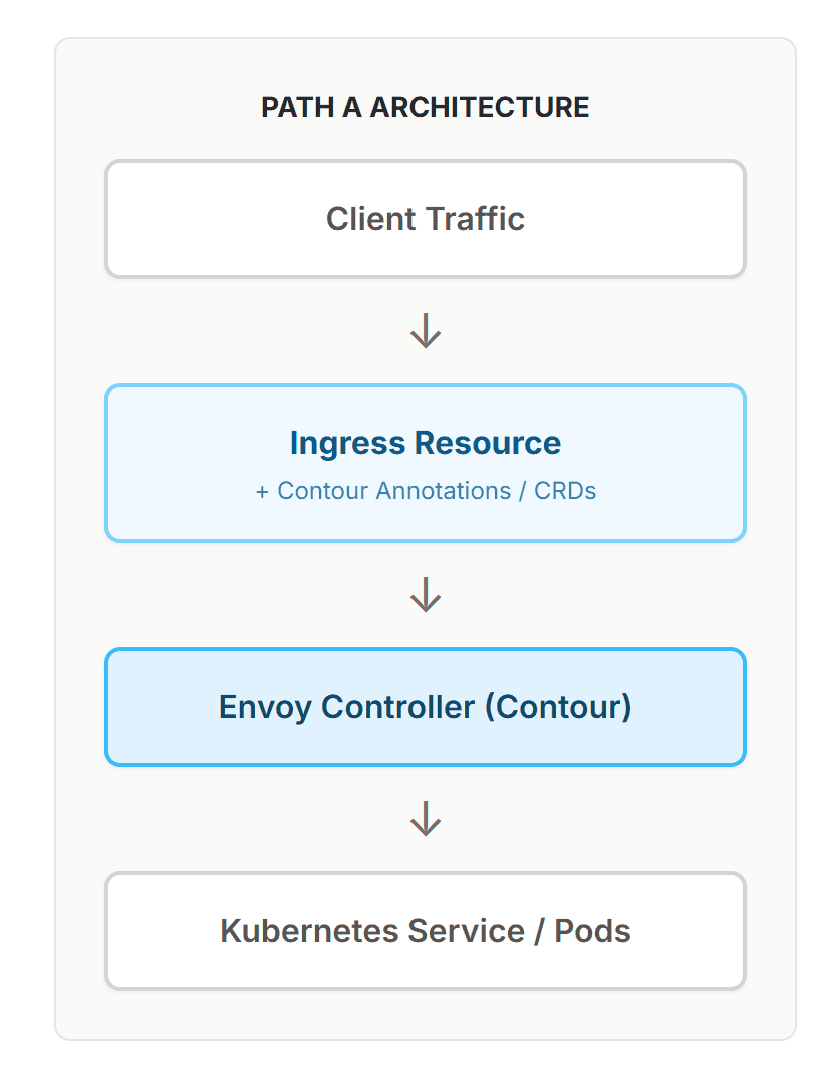
How it Works: Operators can keep their existing Ingress YAML resources and simply swap the underlying ingress class to an Envoy-based controller like Contour. This minimizes immediate disruption to standard routing definitions.
Handling Annotations: While the base Ingress resource stays the same, all of the proprietary nginx.ingress.kubernetes.io/* annotations will fail. These must be manually translated to Contour’s equivalent annotations or rebuilt using its CRDs.
Path A Architecture
3. Path B: The architectural evolution
Migrating to Gateway API
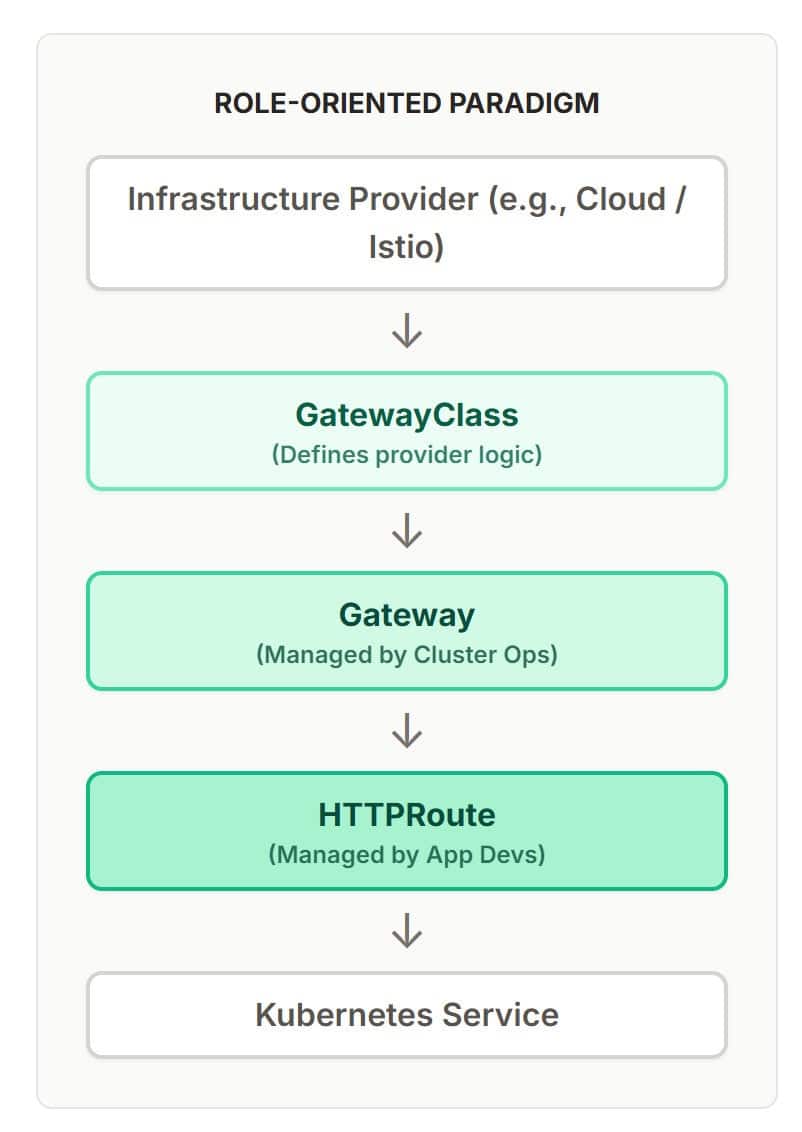
How it Works: The Gateway API is the upstream-backed successor to Ingress. It introduces a role-oriented design that explicitly separates infrastructure concerns from application routing.
Why it Matters: It addresses several structural limitations that made Ingress-NGINX so difficult to maintain. It standardizes traffic splitting, advanced header matching, and secure cross-namespace routing.
Role-Oriented Paradigm
4. Comparative analysis: Pros and cons
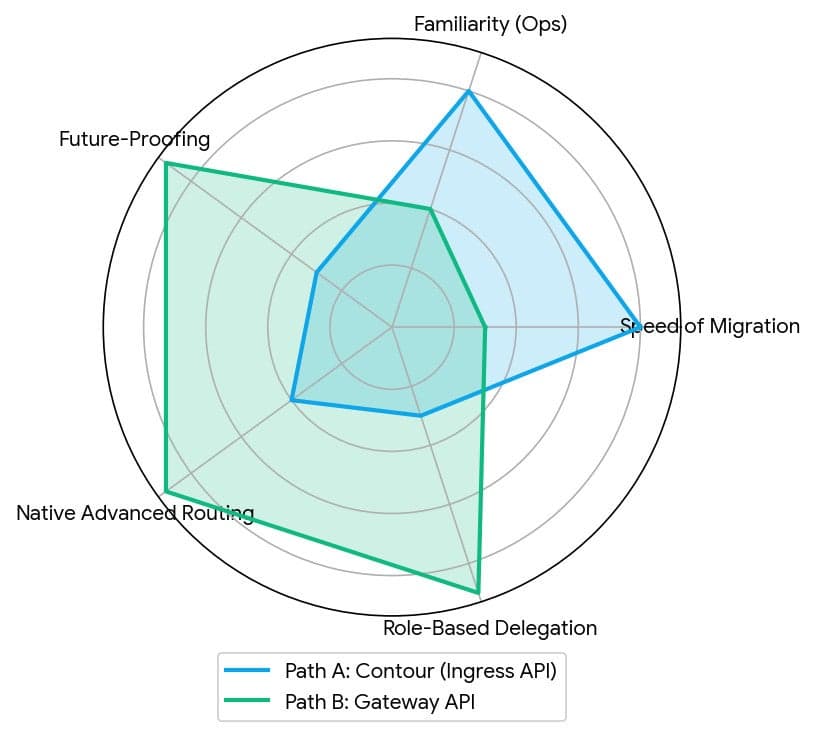
Use this neutral, factual comparison to evaluate which path best aligns with your organizational constraints, timelines, and technical debt tolerance.
| Feature / Factor | Path A: Contour (Ingress API) | Path B: Gateway API |
| Migration Effort | Low to Medium. Translating existing annotations. | High. Complete rewrite of routing manifests. |
| Operational Paradigm | Single-owner. Ops manages monolithic definitions. | Role-based. Ops manages Gateway, Devs manage HTTPRoutes. |
| Future-Proofing | Low. The Ingress API is feature-frozen. | High. Active upstream development. |
| Capabilities | Heavily reliant on proprietary annotations. | Advanced features built into core specification. |
5. Migration strategy and tooling
1. The audit: Meticulously inventory current technical debt (nginx.ingress.kubernetes.io/* annotations).
2. Tooling: Use tools like ingress2gateway to automate translation.
3. Incremental Rollout: Run in parallel, migrate non-critical workloads first.
6. Conclusion: The verdict
If a team is severely time-constrained and lacks the engineering cycles for a refactor, a lateral move to Contour (or another controller) provides additional time for planning and modernization. However, it is a stopgap measure. The Ingress API is feature-frozen. One long-term approach for organizations prioritizing minimal disruption, migrating to another maintained Ingress controller may be the most practical short-term path. Organizations already planning broader platform modernization may find Gateway API provides additional flexibility and capabilities. The appropriate choice depends on operational constraints, migration timelines, and future architectural goals.
Find out how you can accelerate your modernization with KCSP-certified migration services.