


Overview
Kubernetes has fundamentally transformed how enterprises deploy and manage business workloads. As organizations build production applications at scale on Kubernetes, cluster size and complexity continue to grow—creating unprecedented challenges in ensuring cluster security, compliance, and operational consistency.
Kubernetes natively enables developers to deploy workloads declaratively on demand, scale applications dynamically, and iterate rapidly. Unlike traditional IT governance models that rely on manual approval gates, Kubernetes DevSecOps processes must be automated and embedded directly into application development and delivery workflows to better realize the value of cloud native. Kubernetes also provides policy-based admission control mechanisms such as Admission Controllers and ValidatingAdmissionPolicy.
Policy governance frameworks provide built-in security controls based on industry-standard policy engines. This allows enterprise security and operations teams to implement common governance requirements in a codified and automated manner. Furthermore, predefined policy rule libraries are typically available to reduce the learning curve of policy languages and streamline development and operations workflows.
As Policy-as-Code becomes more widely adopted in production, a more flexible solution is needed to cover more complex scenarios and achieve a better balance between policy enforcement and developer productivity—Kyverno offers a Kubernetes-native approach to addressing these challenges.
Why Kyverno?
Kyverno is a Kubernetes-native policy engine. It uses standard CRDs to define and manage policies, providing a simpler and more user-friendly experience. Key benefits include:
- Simple policy language: Policies are written in standard YAML, consistent with Kubernetes manifests. There is no need to learn specialized policy languages such as Rego, lowering the barrier to entry. Kyverno also extends the CEL function library, providing additional capabilities for complex policy expressions.
- Rich feature set: Kyverno natively supports Validate, Mutate, Generate, and Cleanup, covering a broader range of automation and Policy-as-Code scenarios. It also provides robust caching mechanisms, external data calls, and other capabilities to meet enterprise extension needs in specific Policy-as-Code use cases.
- Comprehensive policy library: Kyverno supports Kubernetes-native and multiple policy types, and the Kyverno community provides policy libraries covering many common Kubernetes application scenarios.
- Standardized governance reporting and observability: While enforcing guardrails, enterprises often place even greater emphasis on the “visibility” of policy governance as a basis for continuously improving cluster security posture. Kyverno provides a Reporting mechanism aligned with the Kubernetes Policy Working Group specifications, helping audit whether workloads deployed in the cluster comply with standards and providing timely feedback to developers. Kyverno also integrates with standard cloud-native observability tools and can seamlessly integrate with cloud platform observability solutions.
To illustrate these capabilities, let’s explore how Kyverno addresses common production governance challenges.
Real-world use cases
Kyverno provides native support for Kubernetes and has been integrated by multiple cloud-native policy governance frameworks. It is now officially available for deployment on Kubernetes clusters through standard installation methods and platform marketplaces.
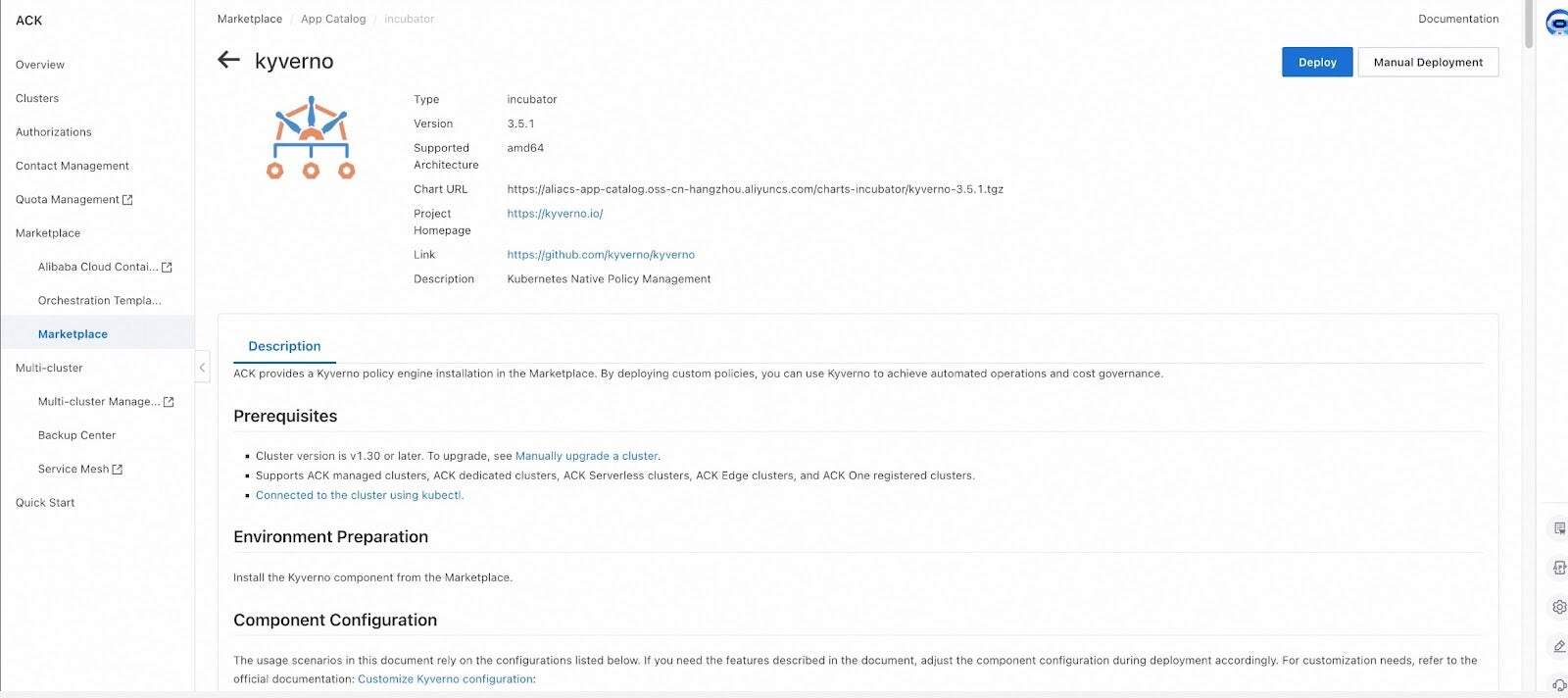
The following examples demonstrate how Kyverno addresses common production challenges.
Case 1: Enforcing Custom Resource (CRD) Deletion Protection
Driven by business needs, enterprises often deploy a large number of CRD resources in production clusters. Preventing accidental deletion of critical production CR instances is a key requirement for security and operations teams.
Within cloud-native policy governance frameworks, pre-built policy libraries typically cannot be aware of users’ custom resource definitions (CRDs). This limitation requires extending via external-provider mechanisms and also requires users to write and deploy specific policies to complete the workflow.
With Kyverno, this can be achieved using clear YAML expressions—friendly to cluster operators who are already familiar with Kubernetes manifests. Policies also support fine-grained resource matching and exemption mechanisms:
apiVersion: policies.kyverno.io/v1alpha1
kind: ValidatingPolicy
metadata:
  name: protect-critical-database-deletion
spec:
  autogen:
    podControllers:
      controllers: []
  matchConstraints:
    resourceRules:
      - apiGroups: ['db.example.com']
        apiVersions: ['*']
        resources: ['databases']
        operations: ['DELETE']
  matchConditions:
    - name: critical-database-instances
      expression: "oldObject.metadata.name in ['critical-db', 'prod-main-db']"
  validationActions: ['Deny']
  validations:
    - expression: "oldObject.metadata.?annotations['kyverno.io/allow-delete'].orValue('') == 'true'"
      messageExpression: '''Deletion of critical database instance '' + oldObject.metadata.name + '' is not allowed unless annotated with kyverno.io/allow-delete: "true"'''
Case 2: Auto-mutating runAsNonRoot and generating network policies
In production operations, automatically applying related resource changes, adding labels/annotations, and dynamically hardening security for specific actions are common requirements. By using a policy engine together with Kubernetes mutating admission capabilities, enterprises can shift these processes from manual operations to automation.
Kyverno provides a more user-friendly mutation experience. Developers can perform resource mutations in a straightforward way using simple YAML patch operations. It also supports:
- Covering existing resources: Scan, report on, mutate, and generate for existing resources in the cluster.
- Automatic generation of related resources: Automatically create related resources such as NetworkPolicies and ConfigMaps based on policies to enable automated configuration.
The following is a typical example of automating a secure-by-default baseline. With the MutatingPolicy below, runAsNonRoot is automatically added to the Pod securityContext when Pods are created:
apiVersion: policies.kyverno.io/v1alpha1
kind: MutatingPolicy
metadata:
  name: add-pod-run-as-non-root
spec:
  matchConstraints:
    resourceRules:
      - apiGroups: ['']
        apiVersions: ['v1']
        operations: ['CREATE', 'UPDATE']
        resources: ['pods']
  mutations:
    - patchType: ApplyConfiguration
      applyConfiguration:
        expression: >-
          Object{
            spec: Object.spec{
              securityContext: Object.spec.securityContext{
                runAsNonRoot: has(object.spec.securityContext) && has(object.spec.securityContext.runAsNonRoot)
                             ? object.spec.securityContext.runAsNonRoot
                             : true
              }
            }
          }
The GeneratingPolicy below enables automatically creating namespace-scoped resources when a Namespace is created or updated:
apiVersion: policies.kyverno.io/v1alpha1
kind: GeneratingPolicy
metadata:
  name: add-networkpolicy
  annotations:
    policies.kyverno.io/title: Add Network Policy
    policies.kyverno.io/subject: NetworkPolicy
    policies.kyverno.io/minversion: 1.15.0
spec:
  evaluation:
    synchronize:
      enabled: true
  matchConstraints:
    resourceRules:
      - apiGroups: ['']
        apiVersions: ['v1']
        operations: ['CREATE', 'UPDATE']
        resources: ['namespaces']
  variables:
    - name: targetNs
      expression: 'object.metadata.name'
    - name: downstream
      expression: >-
        [
          {
            "kind": dyn("NetworkPolicy"),
            "apiVersion": dyn("networking.k8s.io/v1"),
            "metadata": dyn({
              "name": "default-deny",
            }),
            "spec": dyn({
              "podSelector": dyn({}),
              "policyTypes": dyn(["Ingress", "Egress"])
            })
          }
        ]
  generate:
    - expression: generator.Apply(variables.targetNs, variables.downstream)
The Kyverno community’s policies project provides representative policies across a range of Kubernetes application scenarios and best practices. Interested readers can explore it to discover more possibilities with Kyverno.
Intelligent Policies × Security Governance Closed Loop
In the evolution of cloud-native security governance, Kyverno and AI Agents transcend a unidirectional toolchain—they form golden partners in constructing a dynamic “Perceive-Decide-Protect-Evolve” closed-loop system.
AI Agent Empowers Kyverno: From “Policy Configuration” to “Intelligent Governance”
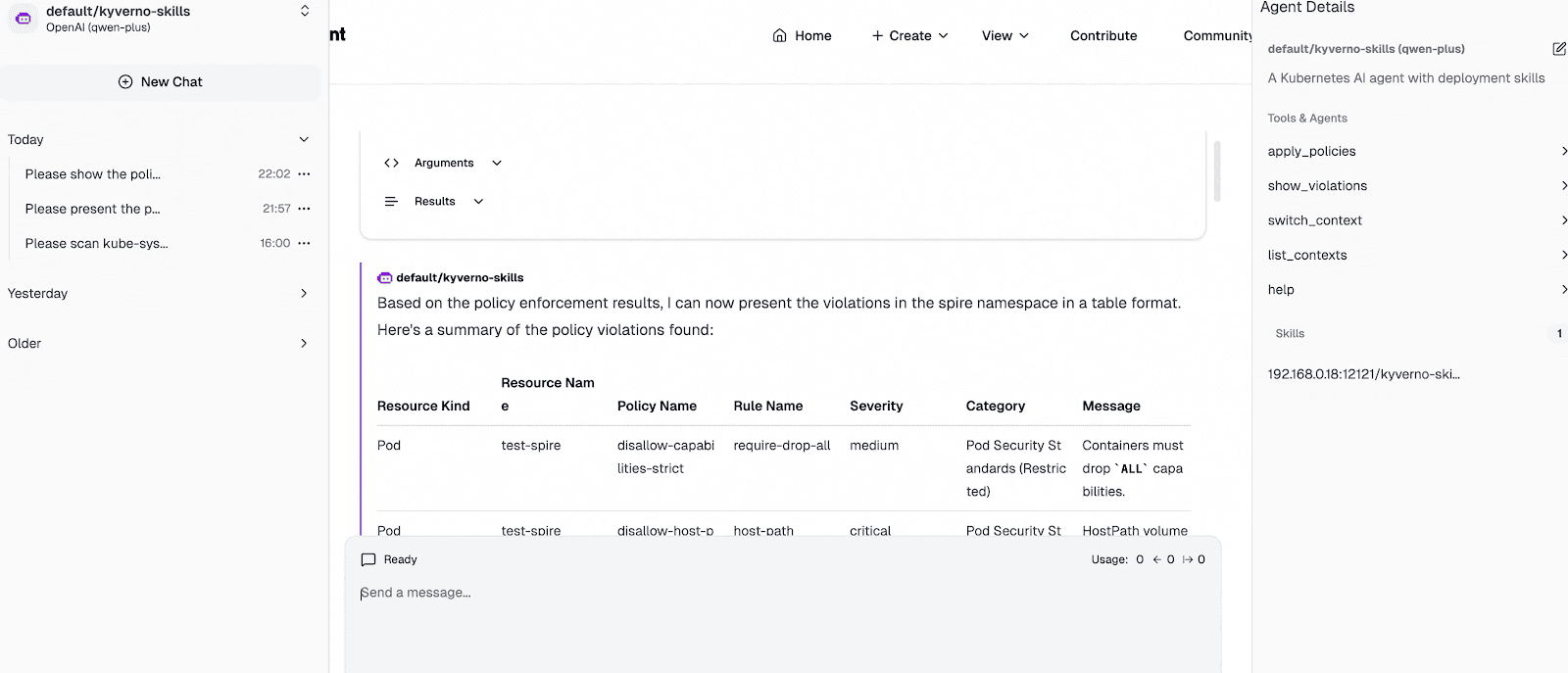
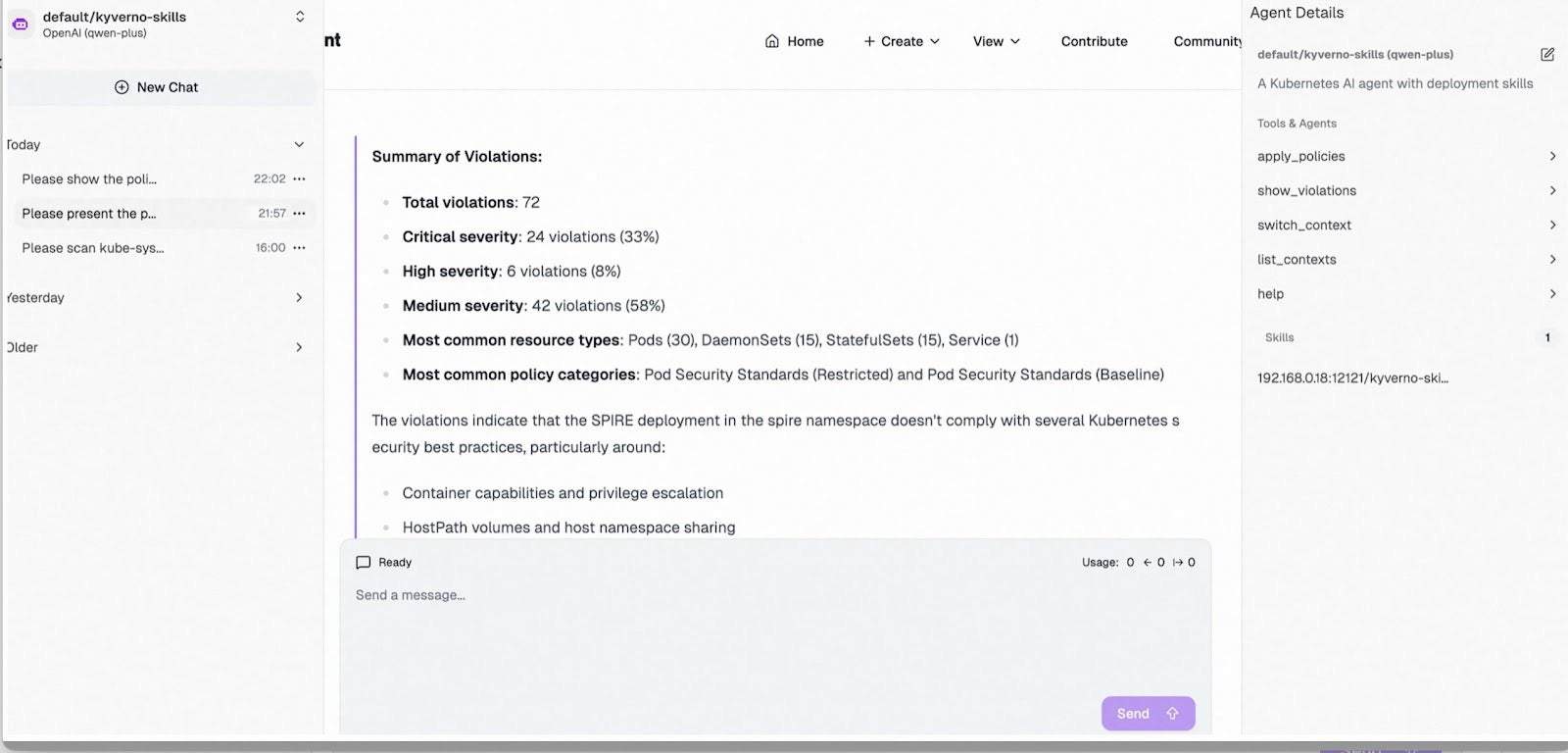
Leveraging MCP/Skills integrated within the Agent and powered by LLM, SecOps teams can achieve one-click deployment of Kyverno alongside policy sets tailored for typical scenarios. The solution automatically scans workload configurations across defined cluster scopes for diverse compliance and baseline requirements, generating visualized security posture reports to precisely identify high-risk elements (e.g., privileged containers, sensitive volume mounts) and misconfigured authorizations. This transforms traditional “manual inspections” into “minute-level intelligent insights,” enabling security policy design with both foresight and precision.
Modern Kubernetes clusters support automated installation, deployment, and configuration capabilities for Kagent. Cluster security personnel can streamline the end-to-end lifecycle of building, deploying, and managing AI Agents within Kubernetes environments. Based on standardized MCP/Skills specifications, teams flexibly develop and operate Kyverno policy-focused Agents and MCP Servers directly in-cluster.
The figure below illustrates a Kyverno Agent instance deployed in the cluster. Integrated with Tools from kyverno-mcp, it supports context loading and switching across multi-cluster environments and enables policy governance inspection via the kyverno CLI for rapid security and compliance risk detection. Enhanced with Kyverno-specific Skills, the Agent optimizes policy governance workflows: as demonstrated in the interaction snapshot, it swiftly invokes Tools to evaluate namespace-level risks against best-practice policy sets, ultimately delivering tabular compliance reports and consolidated violation summaries.
Kyverno Safeguards AI Agents: From “Risk Prevention” to “Secure Operation”
When AI Agents, associated MCP Servers, and gateway containers are deployed within the cluster, Kyverno policies instantly step in as the vigilant "security gatekeeper":
- Real-time interception of high-risk configurations: Automatically audit or reject Agent Pods launched with privileged mode, root privileges, missing securityContext, or mounting sensitive host directories.
- Fine-grained AI gateway authorization: Leveraging Envoy’s External Authorization mechanism, Kyverno policies empower AI gateways to enforce identity-aware authorization, achieving fine-grained access control over AI inbound traffic.
- Closed-loop hardening and remediation: Upon risk detection, Kyverno not only blocks non-compliant deployments but also delivers automated hardening and remediation templates—ensuring Agents operate as secure, governed application units within the cluster, not attack vectors.
In today’s era of deep AI and cloud-native convergence, Agents infuse Kyverno policies with contextual intelligence, while Kyverno empowers Agents with operational trust—together closing the loop on a dynamically evolving, self-reinforcing security framework.
Conclusion
In the cloud-native era, security and efficiency are no longer a binary trade-off. Kyverno brings policy governance closer to the Kubernetes user experience by expressing validation, mutation, generation, and cleanup logic in Kubernetes-native resources, enabling teams to enforce standards while keeping workflows simple and scalable.
Looking ahead, the Kyverno community will continue working with cloud vendors to advance interoperable governance capabilities across diverse environments. By co-building open policy libraries, standardized reporting and observability, and seamless integrations with vendor platforms and toolchains, organizations can establish consistent security and compliance baselines – making policy governance a shared, repeatable foundation for cloud-native operations.