


Ten years into CNCF’s journey, one thing hasn’t changed: we still rely on real signals—open source contributions, real-world deployments, and community energy—to understand where we’re headed. Cloud native is now invisible infrastructure, quietly powering our everyday lives. By watching the pace of project activity, we get a front-row seat to how teams are building the future.
We dig into signals like commit frequency, contributor growth, community expansion, and deployment patterns to map where momentum is building and to understand why it matters. These signals give us a transparent way to identify the technologies and approaches that are gaining real traction. It’s not just about what’s popular, but what’s sustainable, what’s solving real problems, and what’s likely to shape the next phase of cloud native infrastructure.
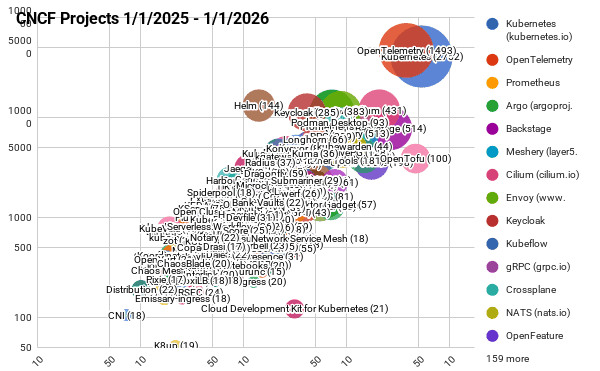
*NOTE: We use bubble charts to show three axes of data: commits, authors, and comments/pull requests, and plot on a log-log chart to show the data across large scales.
- The bubble’s area is proportional to the number of authors
- The y-axis is the total number of pull requests and issues
- The x-axis is the number of commits
Project Velocity: Key Takeaways
Here’s what stands out in the 2025 data:
- Kubernetes continues to lead the ecosystem with the largest contributor base. That sustained velocity reinforces its role as the foundation of modern infrastructure across the enterprise. Kubernetes continues to build upon its success as it evolves to be a critical operating system behind AI.
- Backstage has more than doubled its contributions since 2024. Thanks to its focus on developer experience, it’s the leading open source IDP, playing a foundational role in the rise of platform engineering. As more organizations prioritize internal platforms to accelerate developer productivity and consistency, Backstage is becoming a go-to solution.
- OpenTelemetry is picking up serious momentum, with a 39% rise in commits and a contributor base that grew from 1,301 to 1,756 in just one year; that’s a 35% increase. Now, as the second-largest CNCF project, it’s clear real-time observability is becoming essential to how teams build, run, and scale systems.
What’s exciting is how many of these trends intersect with the rise of AI workloads. Projects like Kubernetes and Kubeflow are increasingly being used as the foundation for training and inference systems. With the launch of the Kubernetes AI Conformance Program and momentum around DRA (Dynamic Resource Allocation), the cloud native community is laying the groundwork for a future where scalable, portable AI runs on open infrastructure.
It’s always inspiring to see the community energy behind these projects. Every contribution matters—whether it’s code, docs, running a meetup, or mentoring someone new. Let’s keep building this future together. All of the current and past reports are available on GitHub.