
A record year for mentorship, 187 graduates contributing to the ecosystem, and one engineer’s journey from “I didn’t know about Docker” to Kyverno maintainer.
In 2025, the CNCF mentorship programs hit a milestone: 187 successful mentorship projects—a record cohort. But the real story isn’t in the numbers alone. It’s in what happens after the mentorship ends.
This year, we’ve been tracking something we call the “mentorship flywheel”—the virtuous cycle where mentees become contributors, contributors become maintainers, and maintainers become mentors who bring in the next generation. The data tells a compelling story, but so do the individuals behind it.
One of them is Mariam Fahmy. Her path from complete newcomer to Kyverno maintainer in under a year illustrates exactly what structured mentorship can achieve—and why it matters for the long-term health of open source.
2025: A record year for cloud native mentorship
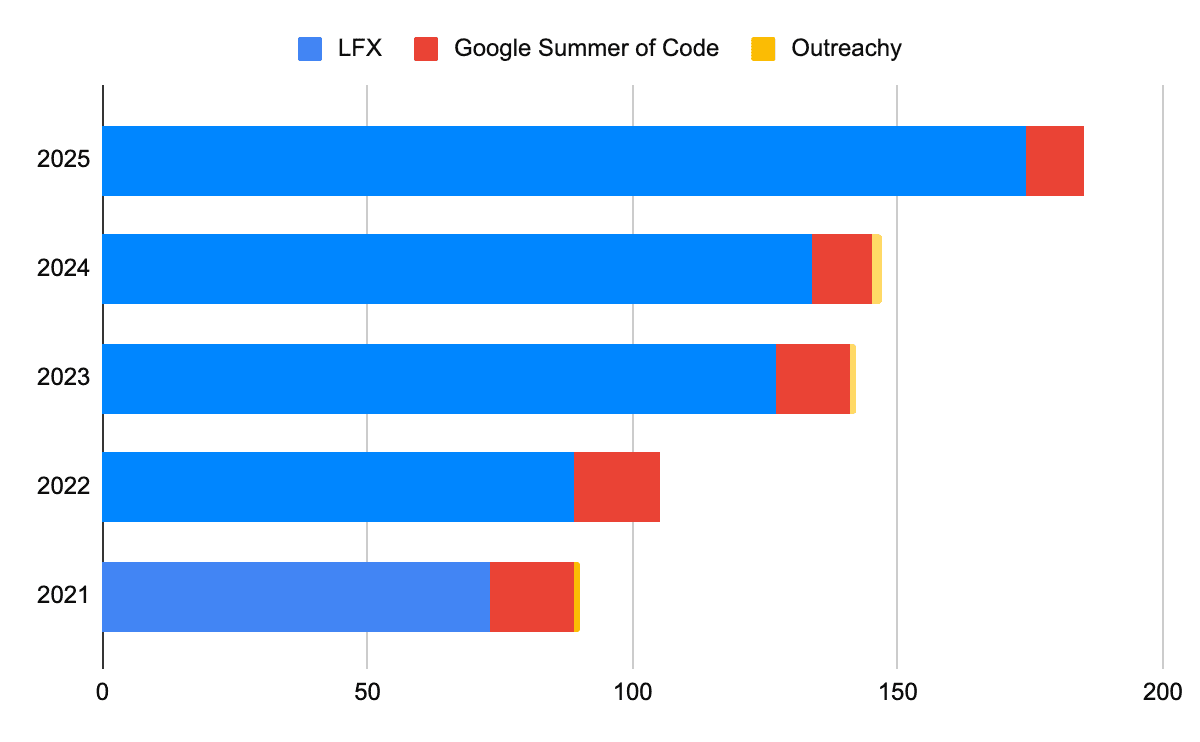
The mentorship programs CNCF participates in—spanning LFX Mentorship, Google Summer of Code, and Outreachy—have grown steadily since 2021. This year’s 187 projects represent not just quantity, but breadth: mentees contributed to everything from Linkerd and Kubernetes to Istio, KubeEdge, and dozens of other projects across the CNCF landscape.
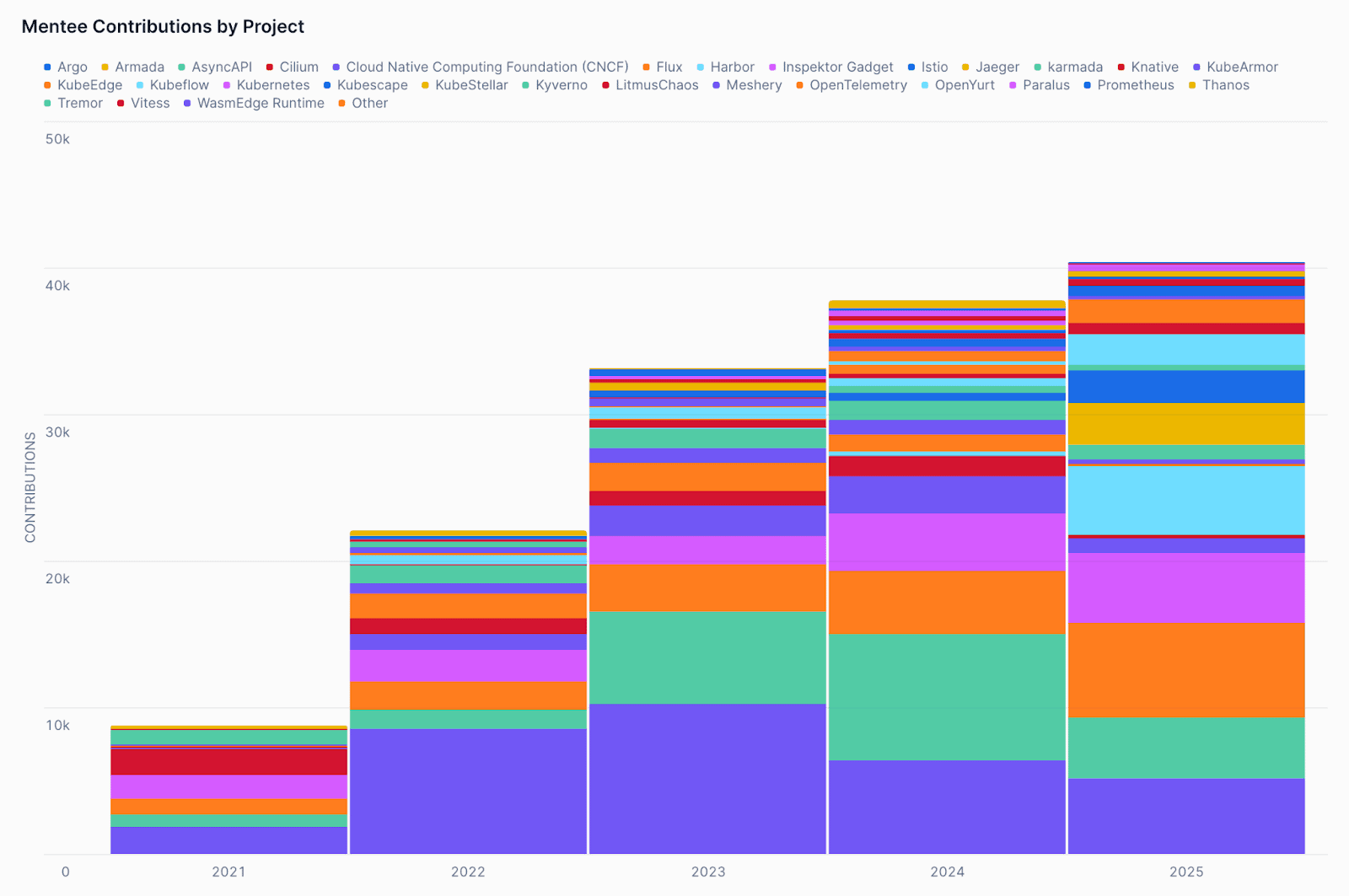
The numbers tell a story of sustained engagement and accelerating growth. CNCF LFX Mentee contributions have increased dramatically year over year—from nearly 10,000 in 2021 to 40,000 in 2025. Across the program’s history, graduates have contributed to projects including KubeEdge, Kubernetes, Istio, Karmada, Harbor, Kubeflow, and dozens more.
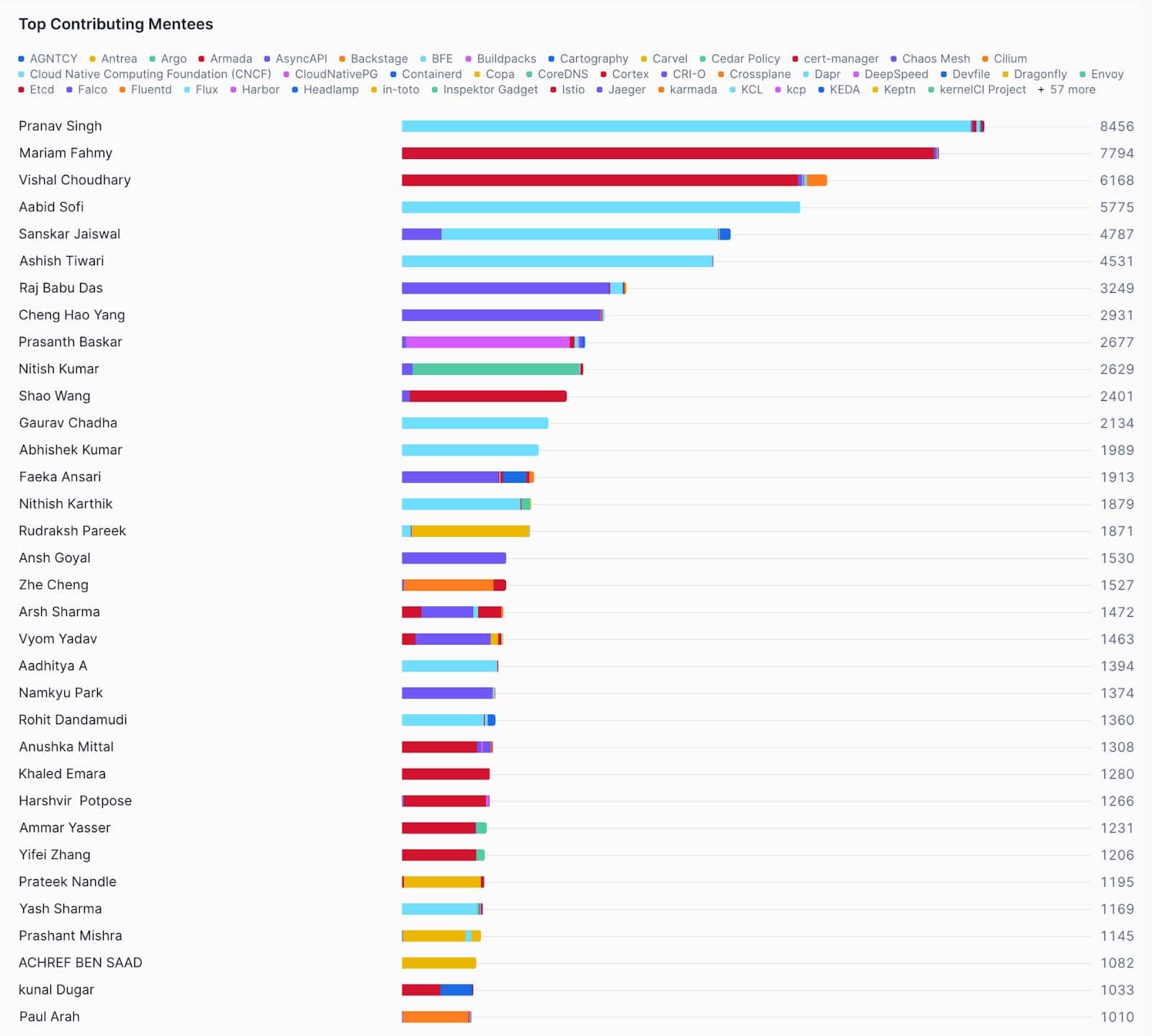
The impact is both deep and wide. Top contributors like Pranav Singh (8,456 contributions), Vishal Choudhary (6,168), and Aabid Sofi (5,775) demonstrate extraordinary sustained engagement. Notably, Mariam Fahmy ranks #2 among all-time top contributing mentees with 7,794 contributions—evidence that her journey from newcomer to maintainer wasn’t just about titles, but about real, sustained work on the project.
The long tail matters too: the leaderboard shows contributors across Antrea, Argo, Armada, Backstage, Cilium, Envoy, Falco, Helm, Jaeger, and other projects—many continuing to contribute years after their mentorship ended.
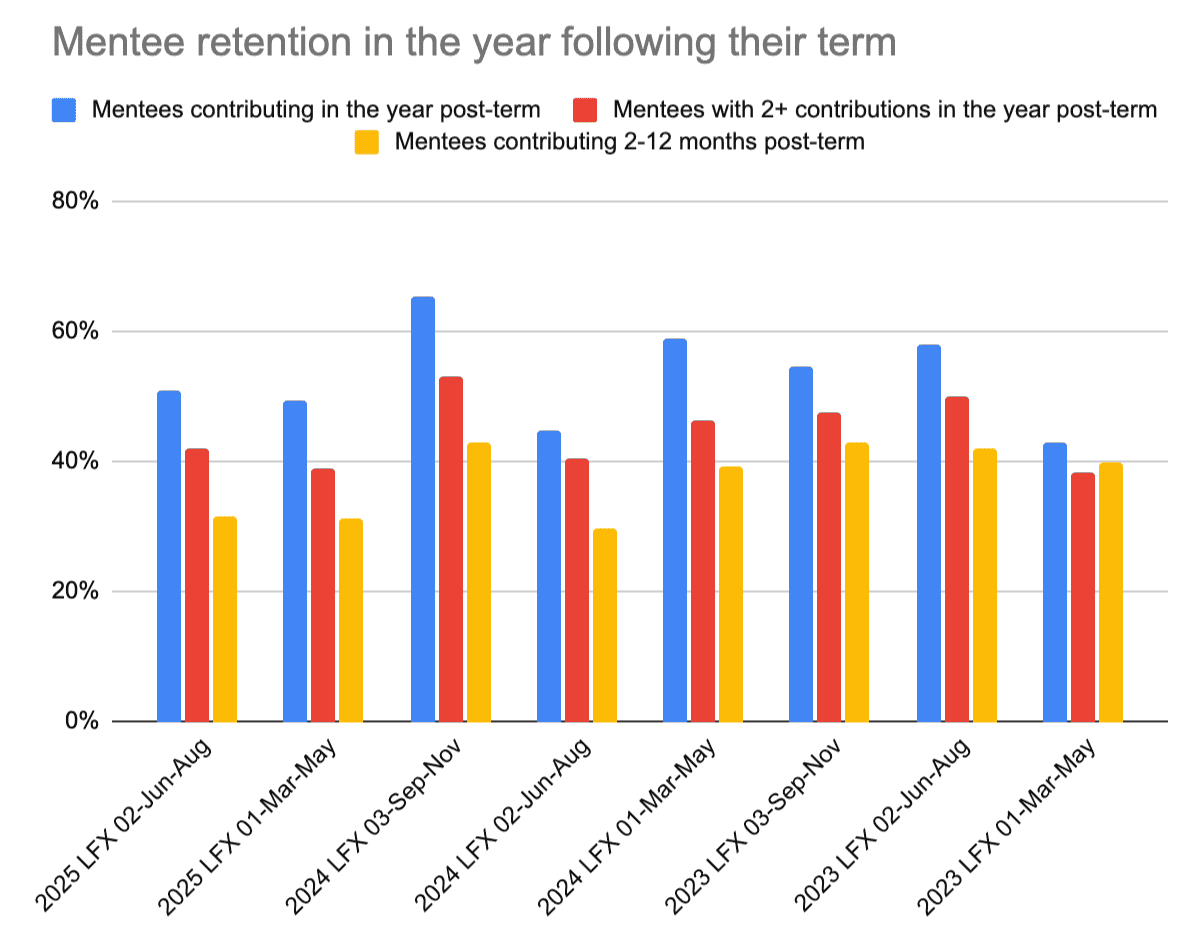
Retention data confirms the pattern. Across recent CNCF LFX Mentorship terms, 40-65% of mentees continue contributing in the year following their mentorship. Many make multiple contributions well beyond their official term. These aren’t one-time participants—they’re becoming part of the community.
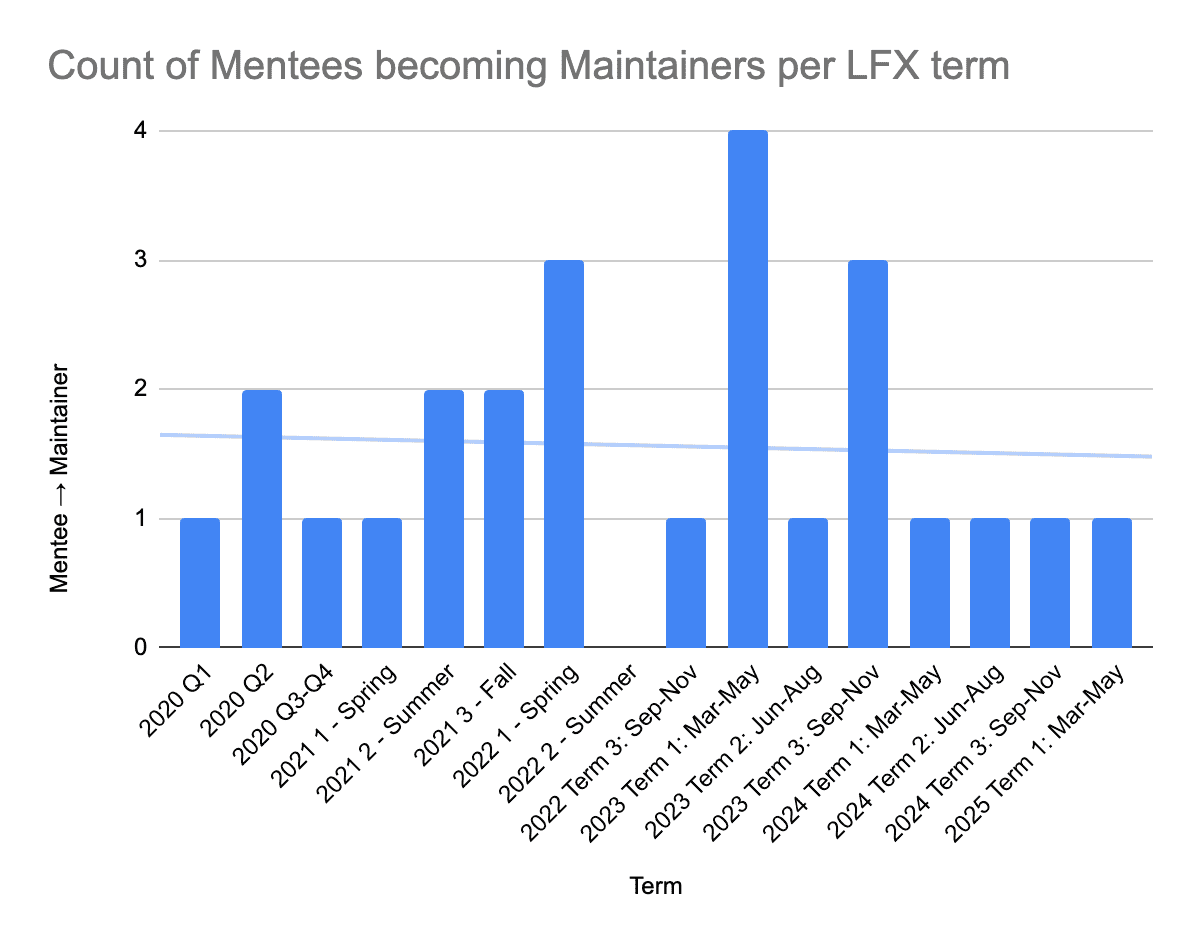
And 25 of them have gone on to become CNCF project maintainers since 2020—the clearest signal that mentorship creates pathways not just to contribution, but to leadership.
Mariam Fahmy: A case study in the flywheel
“One of the steps was to create a Docker image—and I didn’t know about Docker. So I took a Docker course; that course mentioned Kubernetes, so I took a Kubernetes course. After that, the LFX mentorship projects started to make sense.”
That’s how Mariam Fahmy describes the moment everything clicked.
Mariam’s open source journey began with Google Summer of Code in 2022, where she worked on PostgreSQL. That experience opened her eyes to what was possible in open source communities. After GSoC ended, she was eager to continue learning—and that’s when she discovered the CNCF LFX Mentorship program.
“At first I didn’t really know about CNCF,” Mariam admits. “I read about it, and to be honest, I didn’t understand any of the projects at first.”
Rather than giving up, she did something that would set the tone for her entire journey: she got curious. She browsed previous mentorship terms, looking at past projects to understand what kinds of work was being done. When she found one project that included a small task for applicants—creating a Docker image—she decided to try it, even though she’d never used Docker.
“It was like falling down a rabbit hole—in the best way,” she explains. Docker led to Kubernetes, which led to understanding the CNCF ecosystem, which led to discovering Kyverno.
Finding Kyverno
Kyverno, a Kubernetes-native policy engine, caught Mariam’s attention for a practical reason: it felt more approachable than contributing to Kubernetes itself.
“I find it easier to contribute than contributing to Kubernetes itself, because it’s huge,” she says. “Till now I can’t get myself to contribute there.”
What made the difference was documentation. “The documentation was very, very good. I followed the documentation, and all the information I needed was there. That helped me take the courage and apply for the project.”
In Term 1 of 2023, Mariam was accepted as a CNCF LFX mentee to work on a significant feature: adding support for Kubernetes Validating Admission Policies (VAPs) in Kyverno. Her mentor was Jim Bugwadia, CEO of Nirmata and a Kyverno maintainer.
The mentorship experience
If discovering Docker was Mariam’s first shock, diving into Kubernetes internals was her second.
“I didn’t know about Kubernetes clients, informers, listers, and all that stuff. I didn’t know that developing for Kubernetes is a bit different than using Kubernetes.”
This is where mentorship made the difference. Jim didn’t just hand her answers—he helped her discover them herself.
“My mentor didn’t just provide answers—he walked me through use cases and helped me discover the solutions myself. That approach boosted my confidence tremendously and taught me how to think critically.”
Jim pointed her toward the right resources, discussed problems with her, and gave her space to learn while providing guidance at key moments. He even encouraged her to submit a KubeCon talk proposal.
“Jim was amazing—he provided guidance while allowing space for exploration. He recommended the right resources, discussed problems with me, and encouraged me every step of the way.”
Ten months to Maintainer
Mariam’s mentorship project focused on three major tasks. She completed the first two during her official mentorship term, and then something unexpected happened: Jim suggested she become a co-mentor for the third task in a subsequent mentorship term.
“Because I was aware of the code and the background of the feature, I was able to help,” she explains. That experience—shifting from learning to teaching—was a turning point.
After her mentorship ended, Mariam applied to become a Kyverno contributor. She started picking up issues across different parts of the codebase, expanding her knowledge beyond her original project area. Her work on Kyverno and growing responsibilities in the community eventually helped her land a role at Nirmata.
The path from mentee to maintainer took about ten months. “I thought that becoming a maintainer was far off, but with continuous contributions and guidance, it became a natural next step,” she reflects.
Her PR adding her as a Kyverno maintainer was merged in December 2023, and she was officially added to the CNCF foundation maintainer records in January 2024.
The flywheel in action
Mariam’s story illustrates what we call the “mentorship flywheel”—the virtuous cycle where mentees become contributors, contributors become maintainers, and maintainers become mentors who bring in the next generation.
With 7,794 contributions to CNCF projects, she now ranks among the top five most active mentorship graduates of all time. She’s mentored multiple CNCF LFX Mentorship terms herself, helping new contributors navigate the same challenges she once faced. “When you feel like you are responsible for some areas in the product, you are likely to be more aware of everything related to that area. This boosted my confidence.”
The Kyverno community played a crucial role in her development. Weekly community meetings where contributors can get live feedback on their pull requests created a welcoming environment. “The Kyverno community was very welcoming. They helped me feel like my contributions mattered and always provided constructive feedback and encouragement.”
Why this matters
Mariam’s journey from “I didn’t know about Docker” to Kyverno maintainer isn’t just an individual success story—it’s one data point in a larger pattern that the numbers confirm.
For projects like Kyverno, mentorship is a strategic investment. It brings in fresh perspectives, helps tackle backlogs, develops new features, and—most importantly—builds the next generation of maintainers who will ensure the project’s long-term health.
For CNCF member companies like Nirmata, mentorship provides a pipeline of contributors who are already shipping production code in the open. By the time Mariam was hired, she had already demonstrated her capabilities through months of public contributions.
And for mentees themselves, the program offers something invaluable: a structured path into cloud native, with guidance from experienced practitioners and a welcoming community that celebrates their growth.
Advice for aspiring contributors
When asked what advice she’d give to someone starting their mentorship journey, Mariam offers this:
“Don’t be afraid to ask questions, and don’t worry if things don’t make sense at first. Pick something small, explore it deeply, and everything else will follow. And most importantly, stay curious.”
If she could go back and tell her mentee-self one thing: “You’re not supposed to know everything—just take the first step, and keep learning. It’s okay to be lost in the beginning.”
Get involved
The CNCF LFX Mentorship program runs three terms per year, offering paid, three-month mentorship experiences across dozens of CNCF projects.
For aspiring mentees: The next application window opens soon. Browse the CNCF Mentoring repository to see available projects, and start exploring the documentation of projects that interest you—just like Mariam did.
For maintainers: Consider proposing a project for the upcoming term. Mentorship isn’t just about giving back—it’s a strategic way to grow your contributor community, develop future maintainers, and advance your own leadership capabilities.
For everyone: Join the conversation in the CNCF Slack #cncf-mentoring channel or participate in GitHub Discussions.
Mariam’s journey shows what’s possible when curiosity meets community. Somewhere out there, someone is browsing some project’s documentation, trying to understand what Kubernetes is, wondering if they belong in cloud native.
They do. And programs like CNCF LFX Mentorship are here to help them find their way.
Mariam Fahmy is a Software Engineer at Nirmata and a maintainer of the Kyverno project. She first participated in the CNCF LFX Mentorship program in Term 1, 2023.
The CNCF LFX Mentorship program is administered by Nate Waddington, Head of Mentorship and Documentation at CNCF. For more information about mentorship opportunities, visit github.com/cncf/mentoring.